WordPress Bitcoin Invoice Form

With the Coinsnap Bitcoin Invoice Form Plugin, you can easily accept Bitcoin payments for invoices on your WordPress website – directly, securely, and without intermediaries. The plugin is free, easy to install, and connects seamlessly to Coinsnap or a BTCPay Server.

1. Introduction: Accept Bitcoin Payments Easily

Allow your customers to pay invoices not only by bank transfer but also in Bitcoin – directly on your own website.

The Bitcoin Invoice Form by Coinsnap enables you to accept Bitcoin payments directly on your WordPress website.
If you currently send invoices that customers pay via bank transfer, you can now give them the option to pay with Bitcoin instead.

Your customers simply open a payment page on your website and settle their invoice in Bitcoin – fast, transparent, and secure.

Coinsnap also provides an HTML-based solution that can be embedded into any website.
For WordPress, we have a dedicated plugin that you can install and configure with just a few clicks — no technical expertise required.
The plugin supports both Coinsnap and BTCPay Server as payment gateways.

2. Benefits of the Bitcoin Invoice Form Plugin

A simple, flexible, and free solution to start accepting Bitcoin payments on your WordPress site.

  • ✅ Accept Bitcoin instead of bank transfers – offer your customers a modern, fast payment option.
  • 🌐 Payments directly on your website – no external redirects or third-party pages.
  • ⚡ Direct payments to your wallet – via Coinsnap or BTCPay Server.
  • 🆓 Completely free to use – no hidden fees or setup costs.
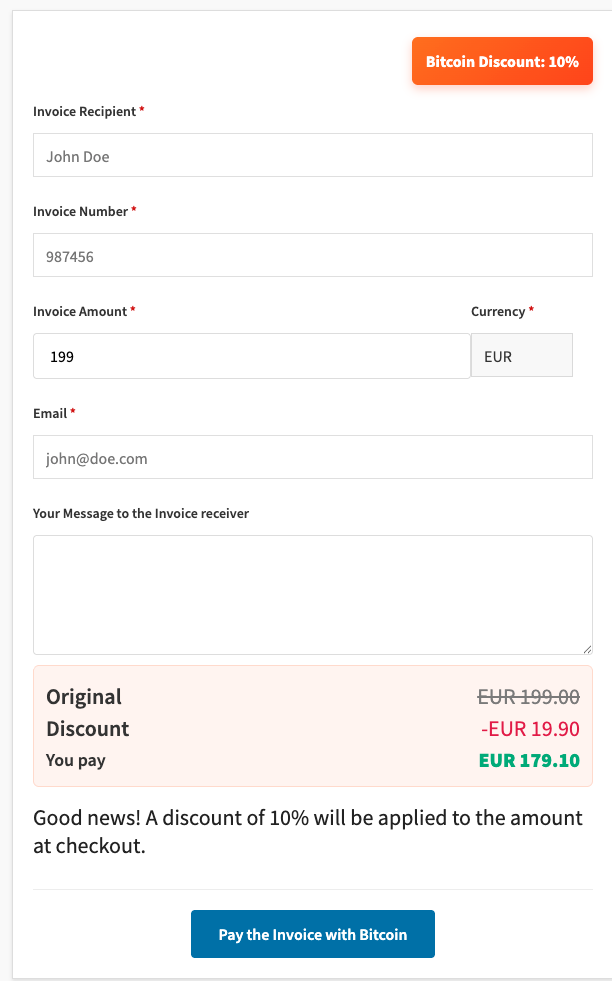
  • 🎁 Bitcoin Discount support – reward customers who pay in Bitcoin.

3. The Bitcoin Invoice Form from the Customer’s Perspective

Customers pay directly on your site by entering the invoice number and amount — simple, secure, and transparent.

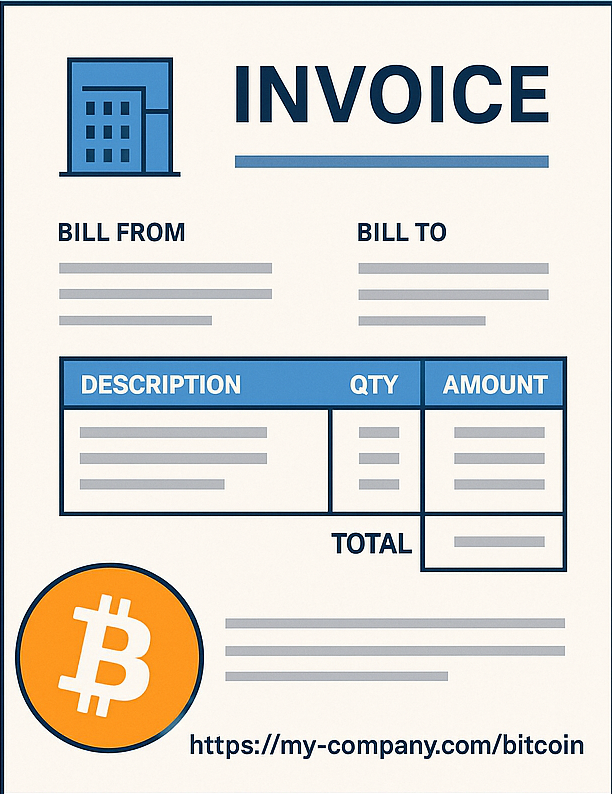
When your customer receives an invoice, it includes a payment URL such as:
👉 https://my-company.com/bitcoin

On this page, the Bitcoin payment form appears.
The customer enters the invoice number and amount, and optionally provides their name, email address, or a message.
All payments take place directly on your domain — no redirection to external processors.

Live demo: https://invoice.coinsnap.org/

4. Installing the Bitcoin Invoice Form Plugin

Install and activate the plugin directly from your WordPress dashboard in just a few steps.

  1. Log in to your WordPress admin panel.
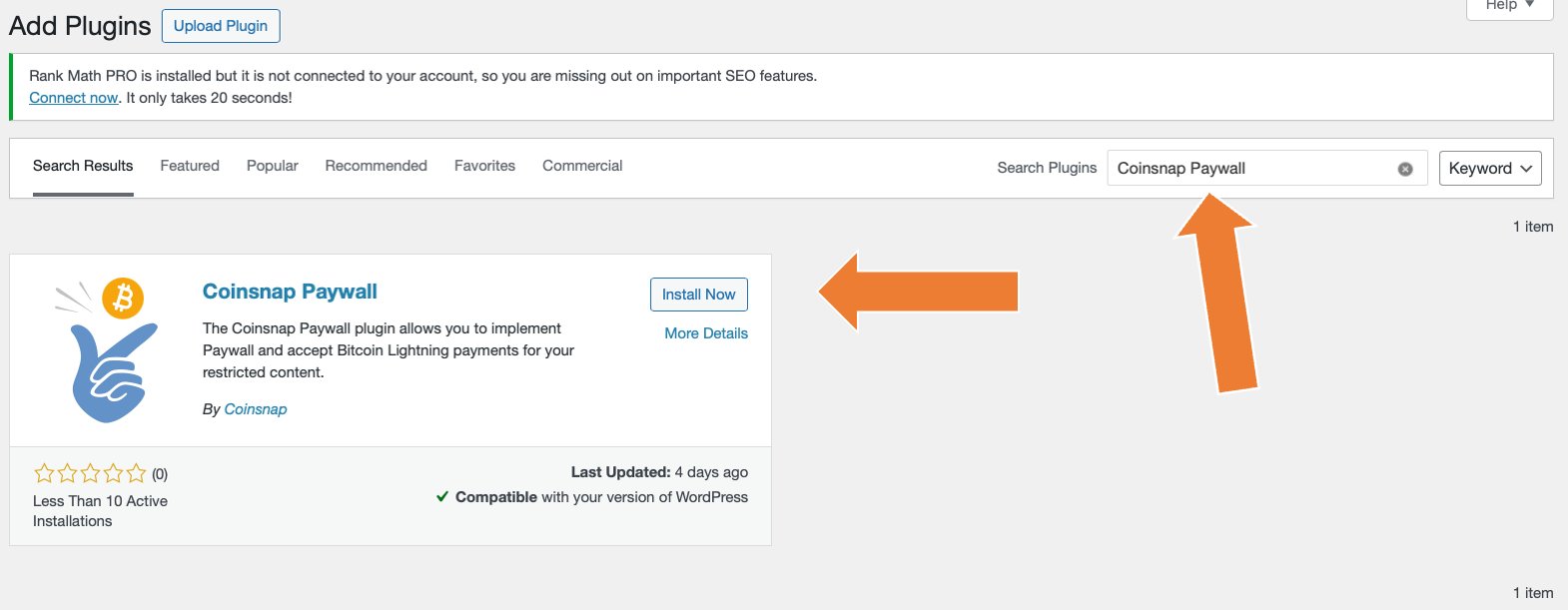
  2. Go to Plugins → Add New.
  3. Search for Coinsnap Bitcoin Invoice Form.
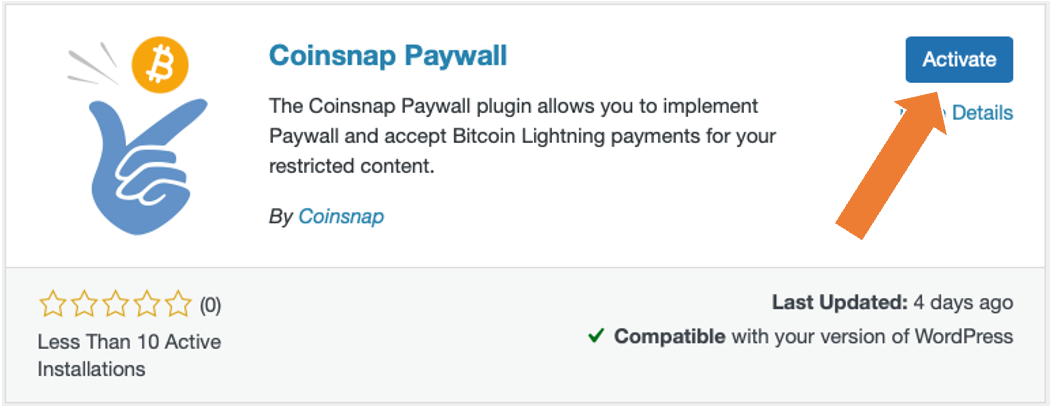
  4. Click Install Now, then Activate.
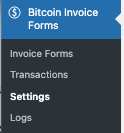
  5. After activation, a new menu item appears: Bitcoin Invoice Forms.

5. Connecting the Plugin to a Payment Gateway

Choose whether to process your Bitcoin payments through Coinsnap or BTCPay Server.

To receive Bitcoin payments, the plugin needs to connect to a Bitcoin payment gateway.
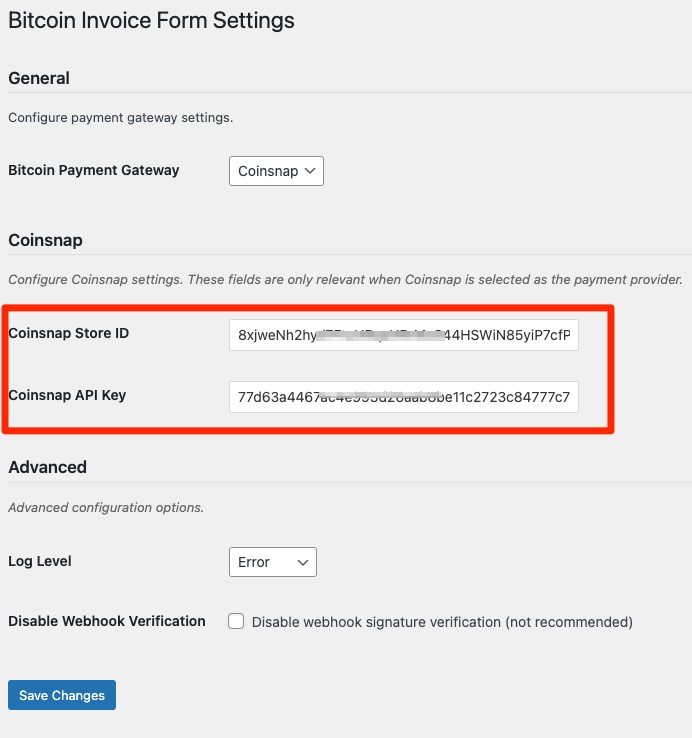
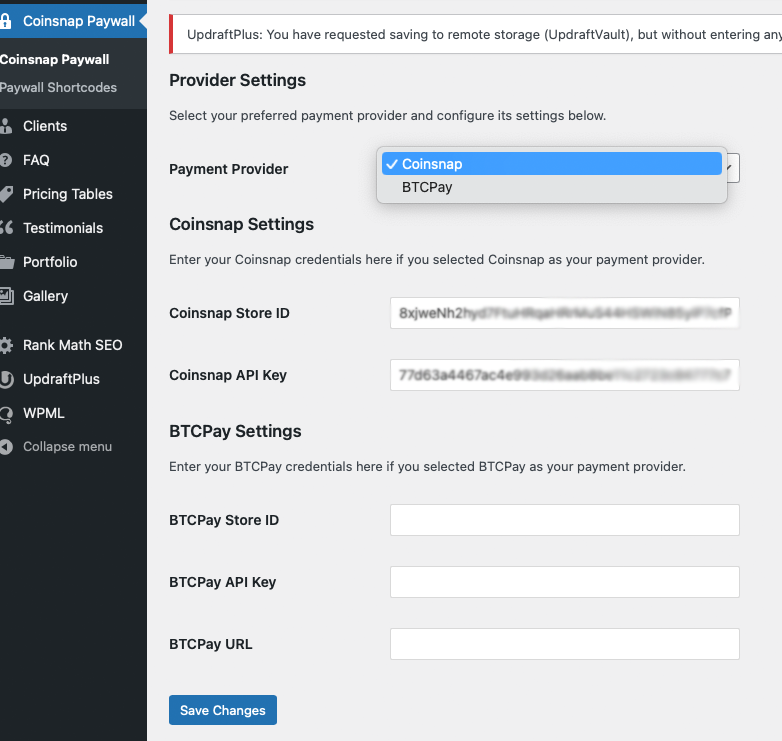
Go to Bitcoin Invoice Forms → Settings, then select your preferred option:

5.1 Bitcoin Invoice Form for BTCPay Server

  1. Log into your BTCPay Server and create a new store.
  2. In the plugin settings, choose BTCPay Server as the gateway.
  3. Enter your BTCPay Server URL.
  4. The configuration wizard connects automatically.

5.2 Bitcoin Invoice Form for Coinsnap

  1. Create a free account at Coinsnap.io.
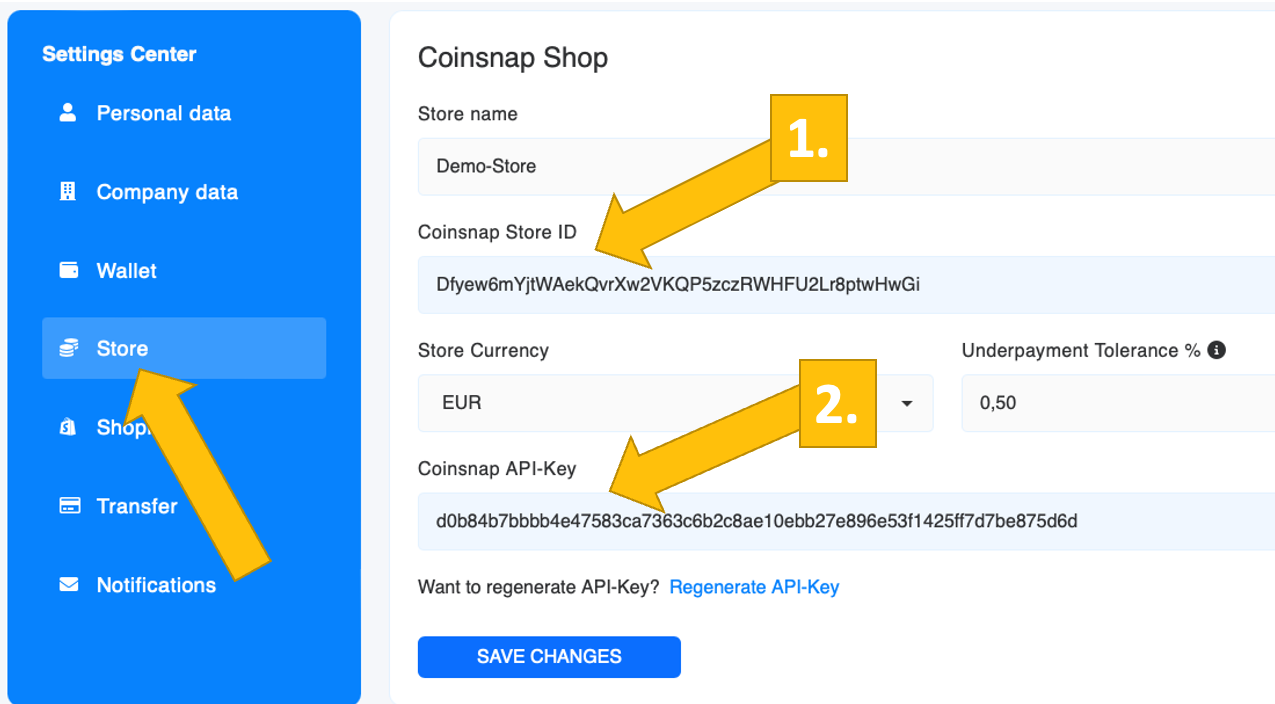
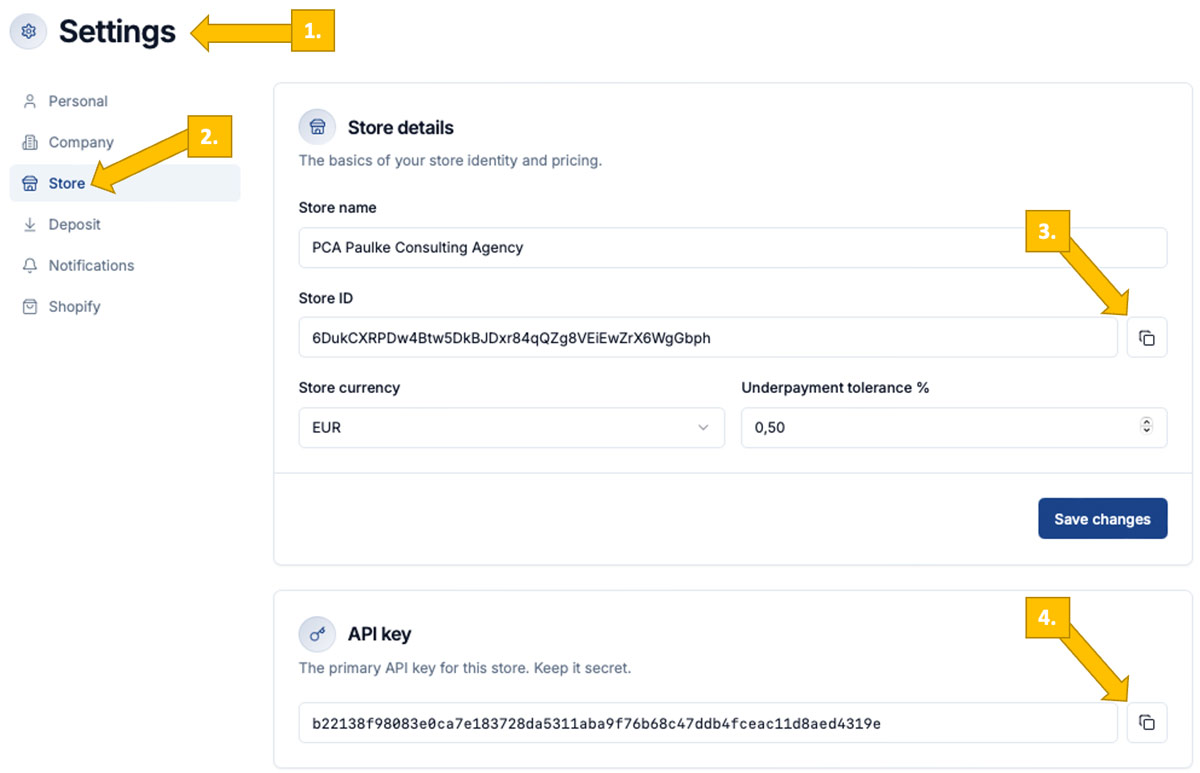
  2. In your dashboard, go to Settings → Store.
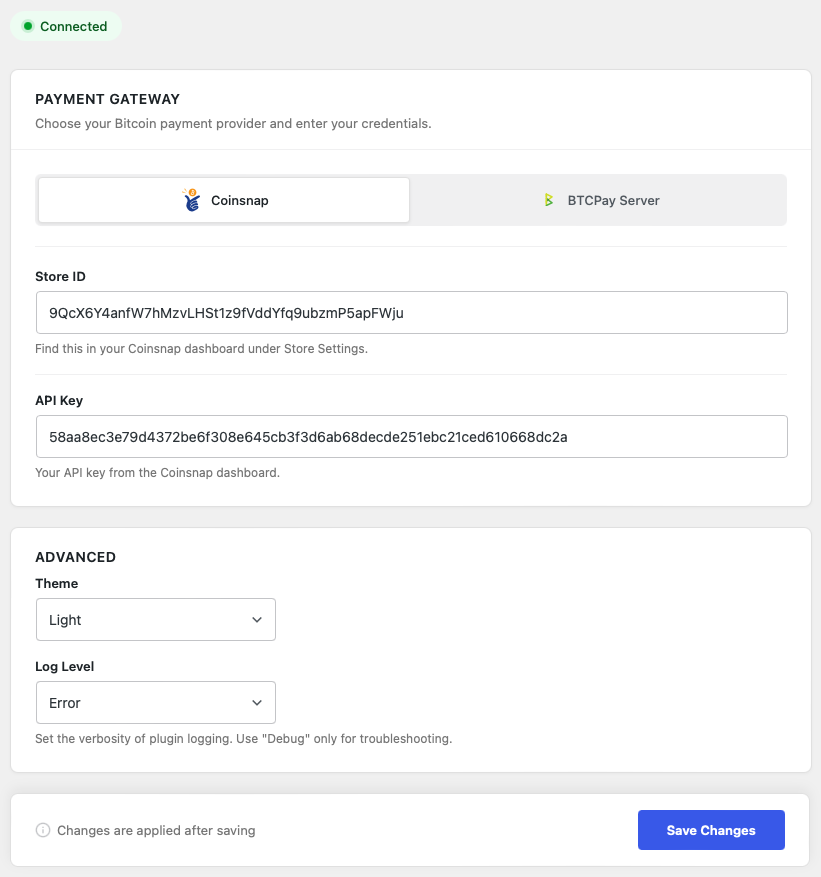
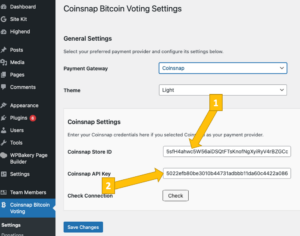
  3. Copy your Store ID and API Key.
  4. Enter both in your WordPress plugin settings under Coinsnap.

Your WordPress plugin is now connected to Coinsnap and ready to process Bitcoin payments.

6. Creating a Bitcoin Invoice Form

Create multiple Bitcoin payment forms — for example, for different languages or brands.

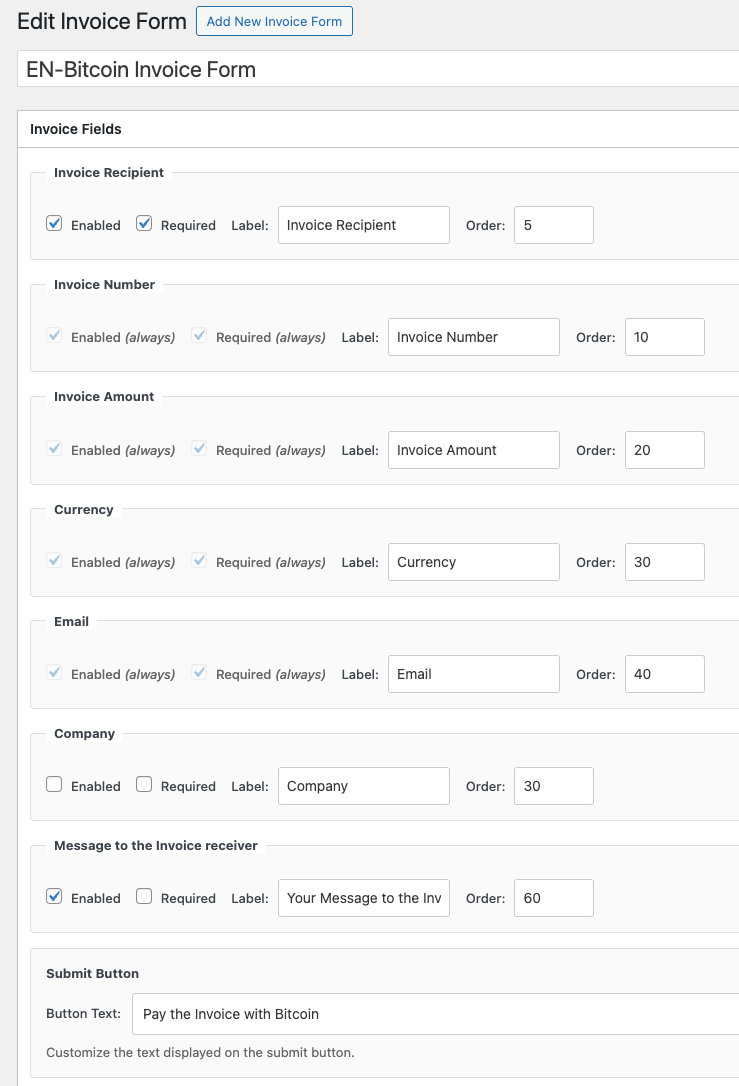
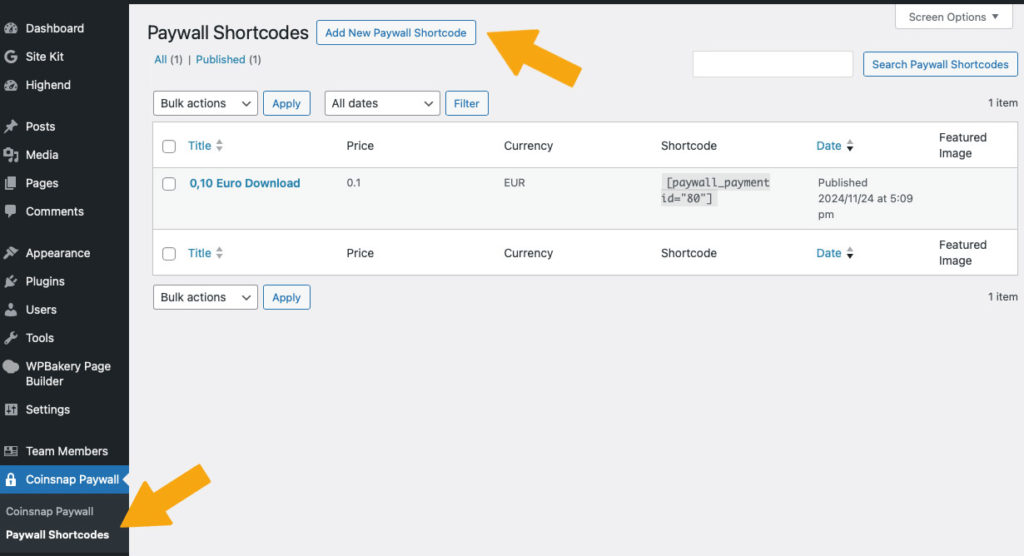
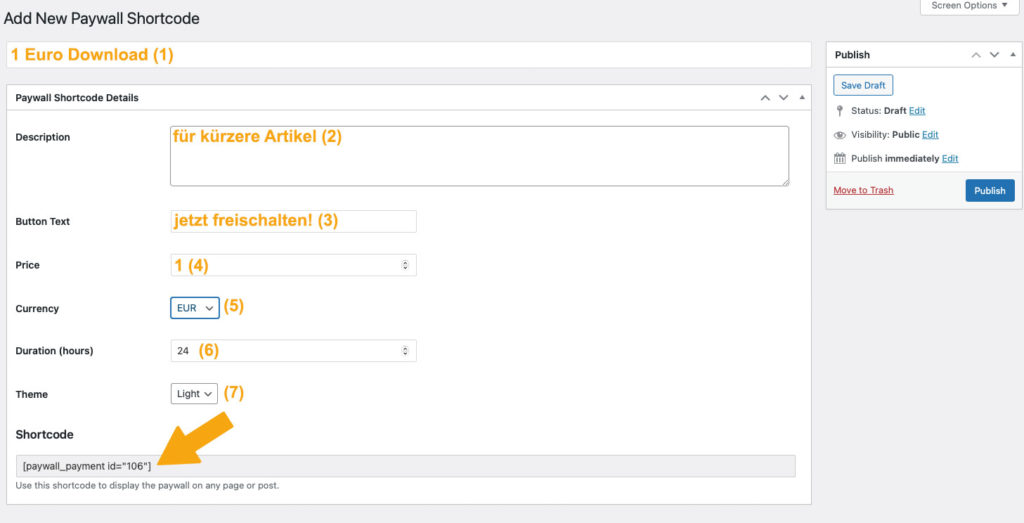
In your WordPress dashboard, go to Invoice Forms → Add New Invoice Form.
You can create multiple forms if your site serves different markets or languages.

  • Invoice Recipient – name of the payer (required)
  • Invoice Number and Invoice Amount – required
  • Currency – invoice currency
  • Email Address – optional for confirmations
  • Message Field – optional message from the customer

7. Bitcoin Discount

Encourage your customers to pay in Bitcoin by offering a discount.

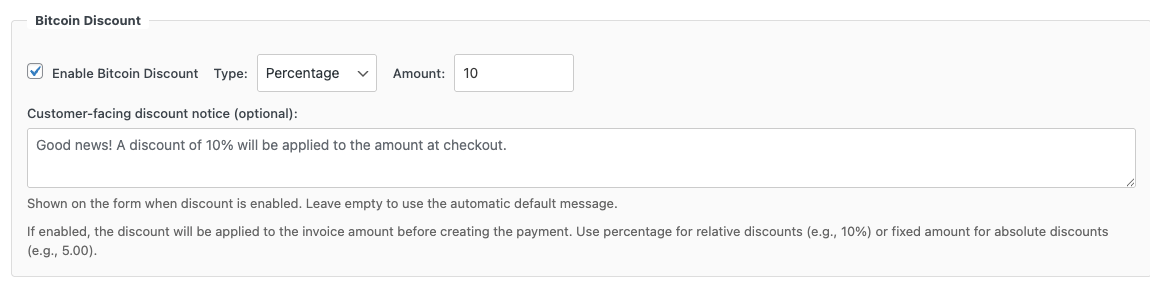
Activate the Bitcoin Discount feature to reward customers who pay with Bitcoin.
You can define either a fixed discount amount (e.g. €10) or a percentage discount (e.g. 10%).

8. Email Settings

Configure who receives email notifications after a Bitcoin payment — you, the payer, or both.

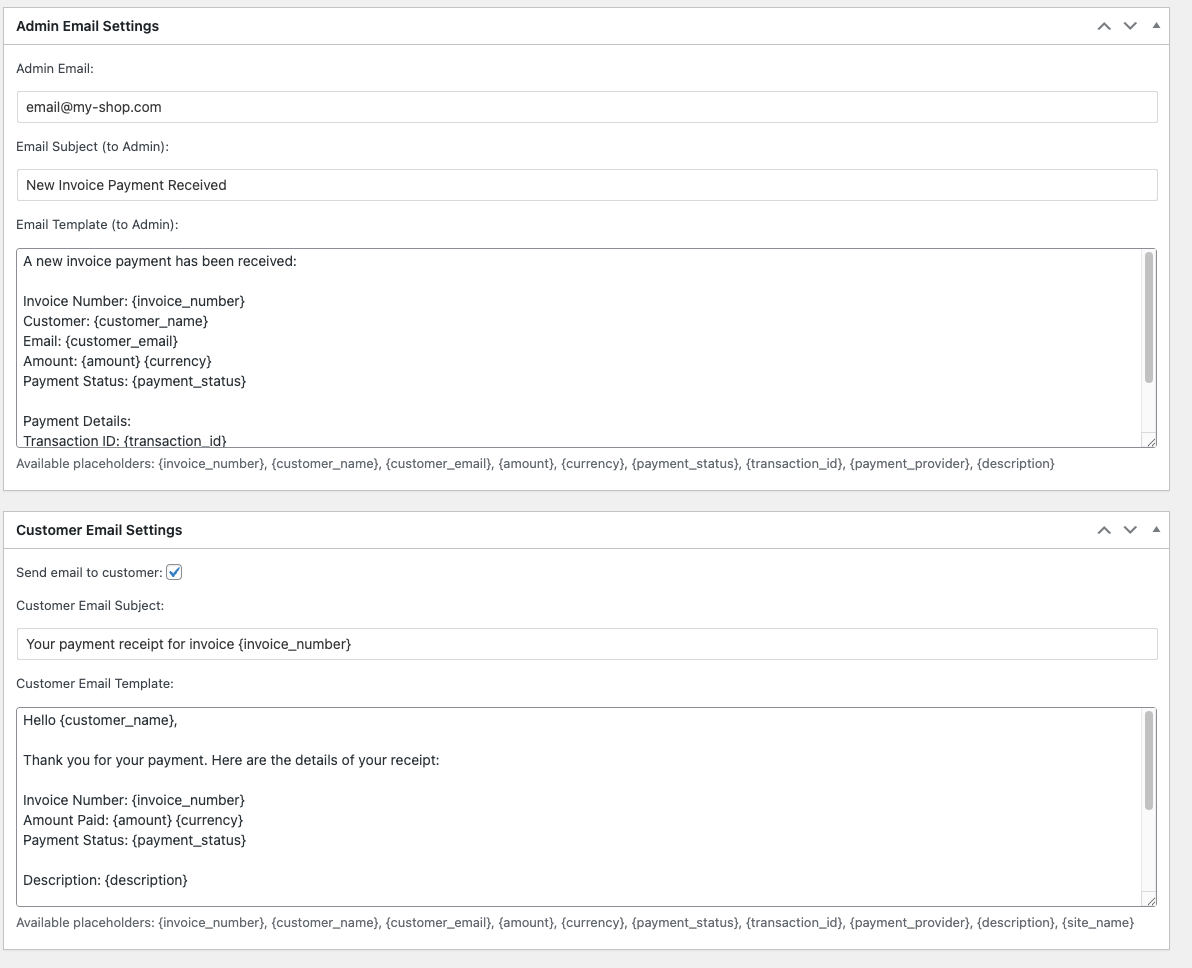
  • The invoice issuer receives an email notification confirming the payment.
  • If Customer Email Settings are enabled, the payer will also receive a confirmation email once payment is successful.

Important: The payer must provide an email address in the invoice form for this to work.

9. Redirect Settings

Control what happens after a payment — redirect users to custom success or error pages.

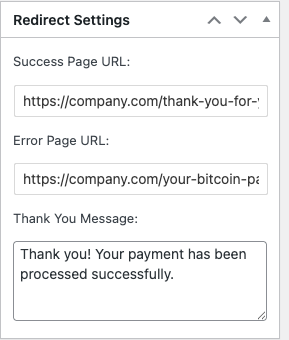
  • Success Page URL: Page shown after successful payment.
  • Error Page URL: Page shown after failed or canceled payment.

We recommend creating two separate pages — one for success (e.g., “Thank You”) and one for errors.
If left empty, a default message appears instead.

10. Shortcode Integration

Display your Bitcoin payment form anywhere on your site using a shortcode.

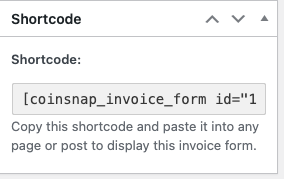
Each form generates a shortcode, for example:

[coinsnap_invoice_form id="12345"]

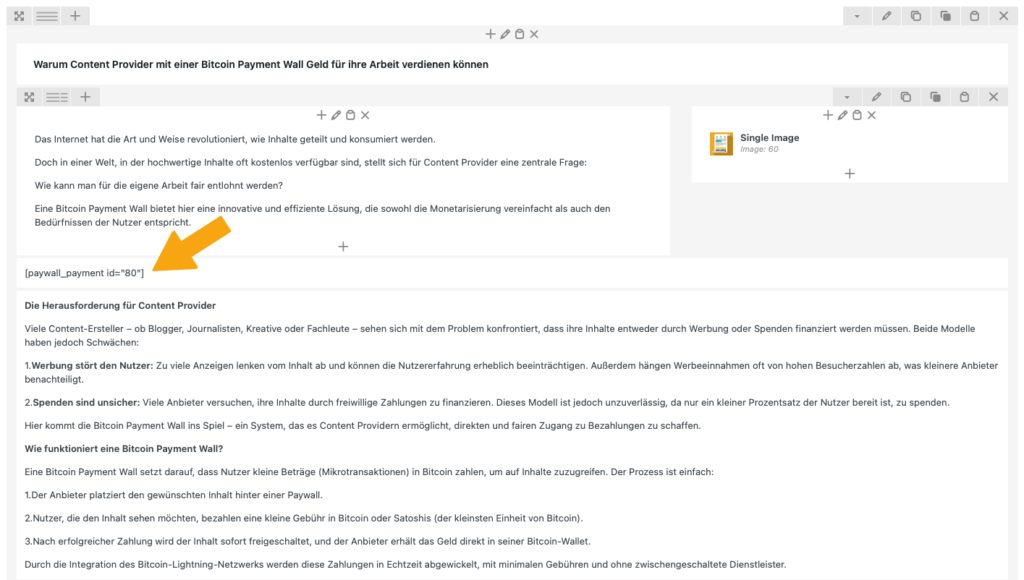
Copy this shortcode and paste it into any WordPress page or post.

11. Transaction Overview

Track every Bitcoin payment and view detailed transaction data.

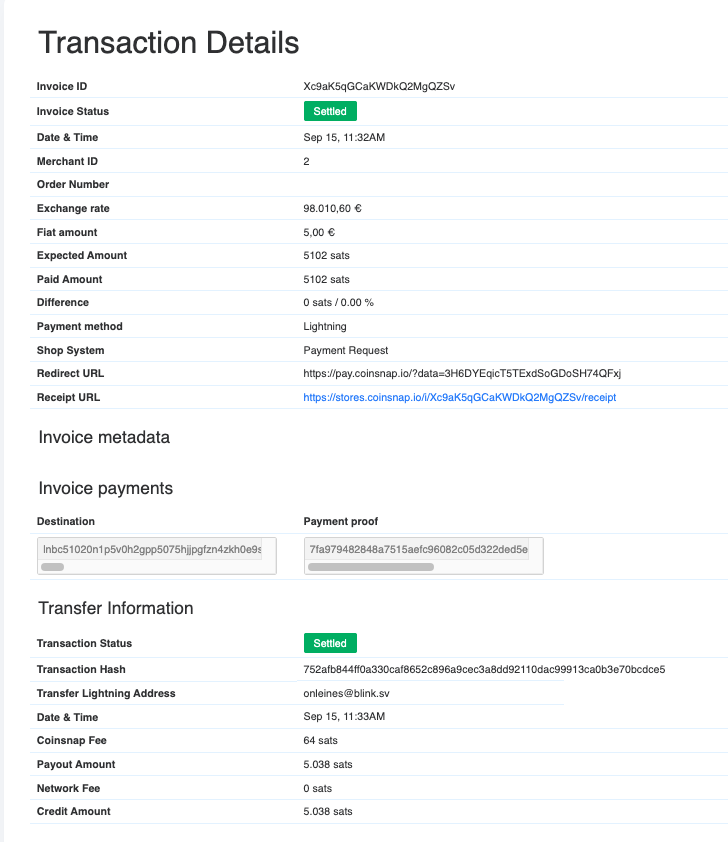
Under Transactions, you’ll find a complete list of all received Bitcoin payments — including invoice numbers, payers, amounts, and payment status.

  • Payment amount in fiat and Bitcoin
  • Exchange rate used for conversion
  • Timestamp of the payment
  • Wallet address that received the funds

These details ensure full transparency and simplify accounting.

Conclusion

The Coinsnap Bitcoin Invoice Form Plugin is the easiest way to accept Bitcoin payments on your WordPress website — transparent, secure, and completely free.
With just a few clicks, you can start receiving payments directly on your site without intermediaries or complex integrations.

👉 Try it live: invoice.coinsnap.org
or install it directly via your WordPress dashboard.

Getting Started Guide: Accept Bitcoin Payments with WooCommerce

Are you running an online store based on WooCommerce and want to accept Bitcoin payments with WooCommerce?
This guide provides a complete step-by-step tutorial with links to detailed articles on our website.

Overview

  1. Create a Coinsnap account
  2. Set up a Lightning Wallet and connect it to Coinsnap
  3. Install the Coinsnap for WooCommerce plugin
  4. Connect the plugin with your Coinsnap account
  5. Customize the plugin settings
  6. Perform test transactions
  7. View transaction data in the Coinsnap dashboard and use it for accounting

1. Create a Coinsnap Account

First, create your merchant account with Coinsnap.
👉 Go to https://app.coinsnap.io/ and register with your email address.
If you have a discount code, you can enter it during registration.
👉 More information: Getting Started with Coinsnap

2. Set Up a Lightning Wallet

Your customers can pay in your WooCommerce store using Bitcoin on-chain or the Lightning Network.
Payments will be credited to you via Lightning, so you need a Lightning Wallet with a Lightning address.

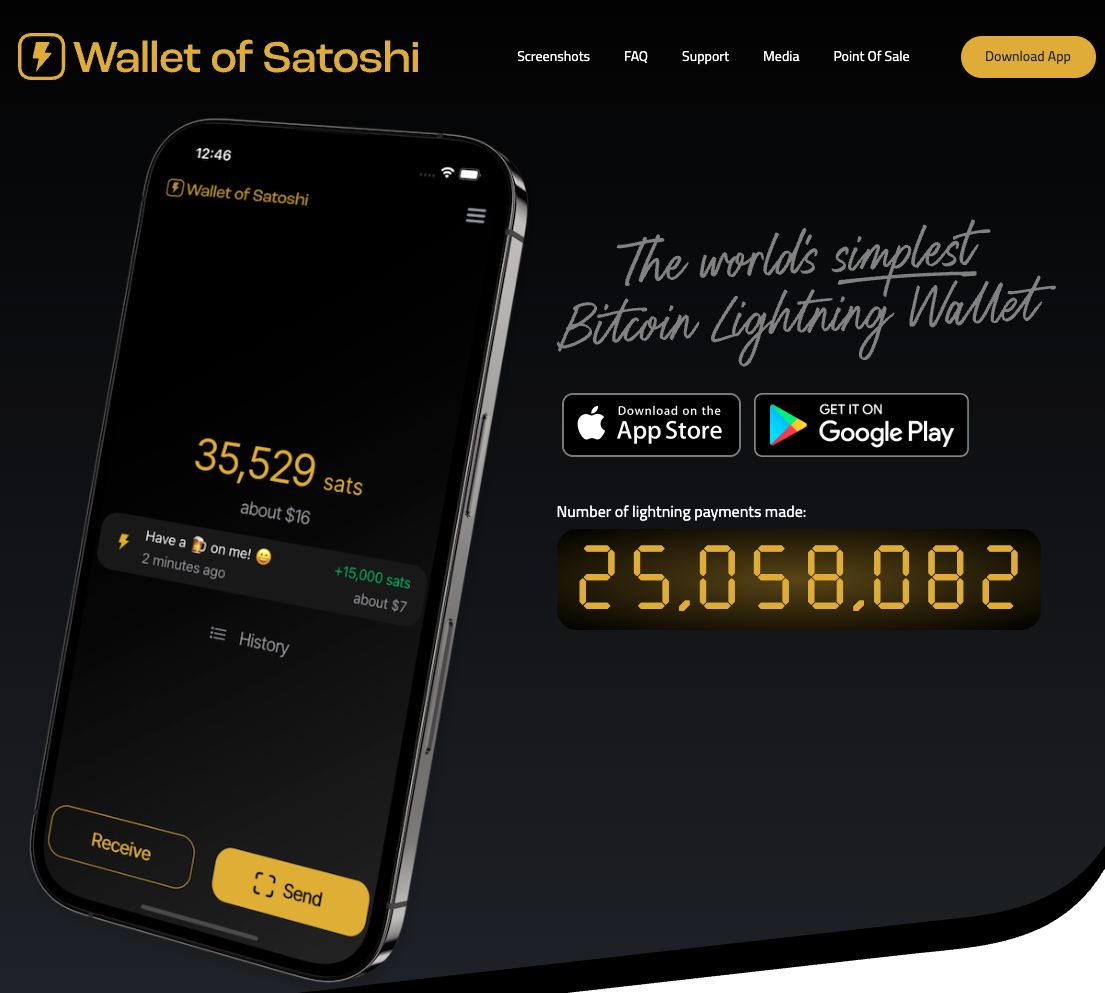
For beginners, we recommend Wallet of Satoshi.
👉 Install the Wallet of Satoshi app from your App Store (iOS or Android).
The app automatically generates a Lightning address for you — it looks similar to an email address but allows you to receive Bitcoin payments.

👉 Example: yourname@walletofsatoshi.com
Your Bitcoin sales will be credited directly to this wallet. You can transfer your Bitcoin at any time to another wallet, e.g. your BitBox02 hardware wallet.
👉 More information:

3. Install the Coinsnap for WooCommerce Plugin

Log in to the admin area of your WordPress website where WooCommerce is installed.

  1. Go to Plugins → Add New
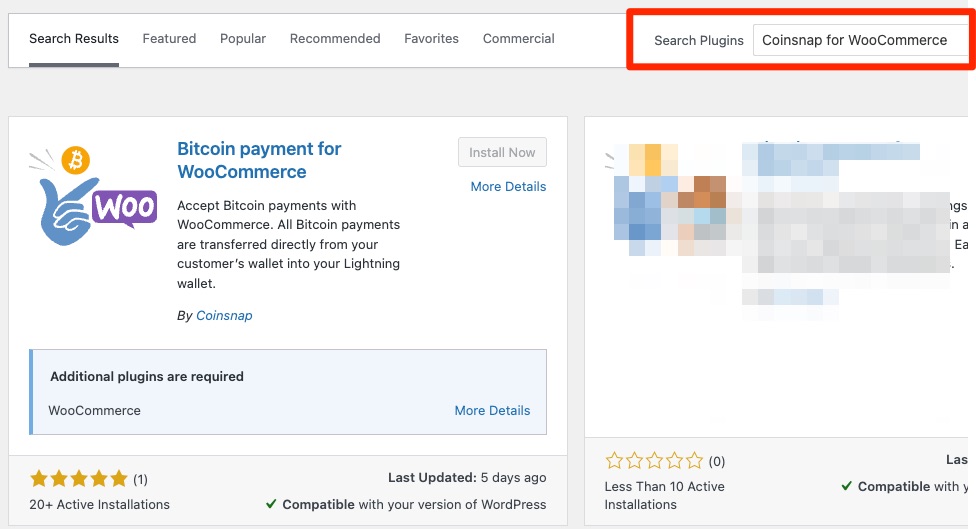
  2. Search for Coinsnap for WooCommerce
  3. Click Install Now, then Activate

👉 Detailed guide:

Coinsnap for WooCommerce Installation Guide

4. Connect the Plugin with Your Coinsnap Account

To enable Bitcoin payments, your WooCommerce store must be connected to your Coinsnap account.

  1. Log in to your Coinsnap Dashboard
  2. Go to Settings → Store
  3. Copy your Store ID and API Key
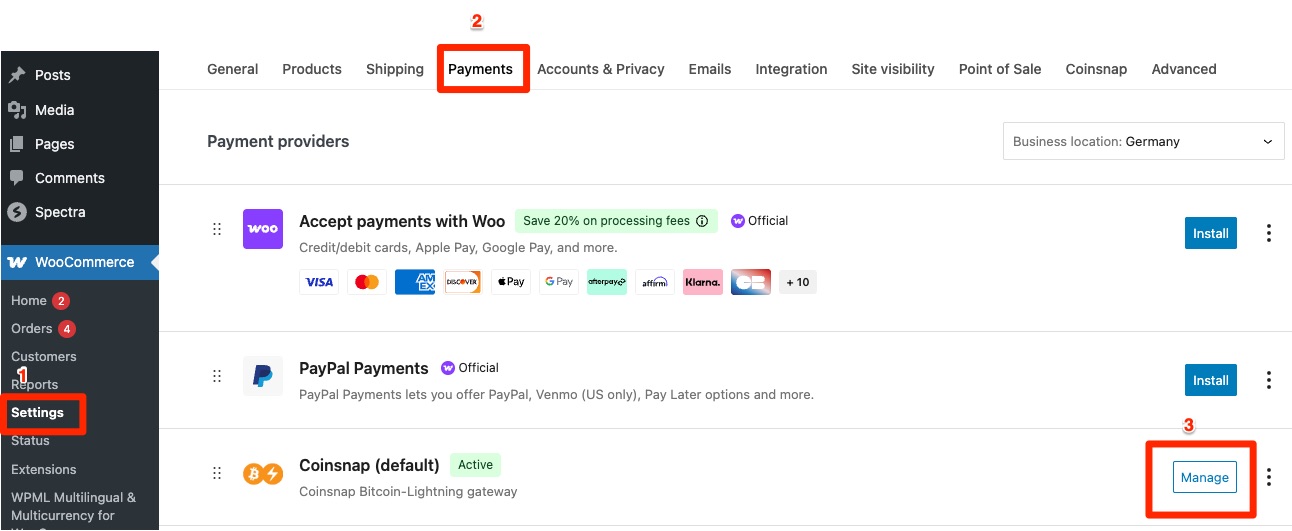
  4. In WooCommerce, go to Settings → Payments → Coinsnap and paste both values into the Coinsnap plugin settings

Once done, your WooCommerce store is successfully linked to Coinsnap.

5. Customize the Coinsnap Plugin Settings

After the connection is established, you can adjust the Coinsnap plugin to match your store’s preferences.
You can, for example:

  • Define how the payment method is displayed to customers (e.g., “Bitcoin + Lightning” or a custom label)
  • Offer a discount for Bitcoin payments
  • Change button text or display labels

You can find these options under WooCommerce → Settings → Payments → Coinsnap.
Click Manage to open the settings panel.

6. Perform Test Transactions

Before you start accepting real payments, we recommend performing two test transactions:

  1. Purchase a product and pay via Lightning
  2. Purchase another product and pay via Bitcoin Onchain

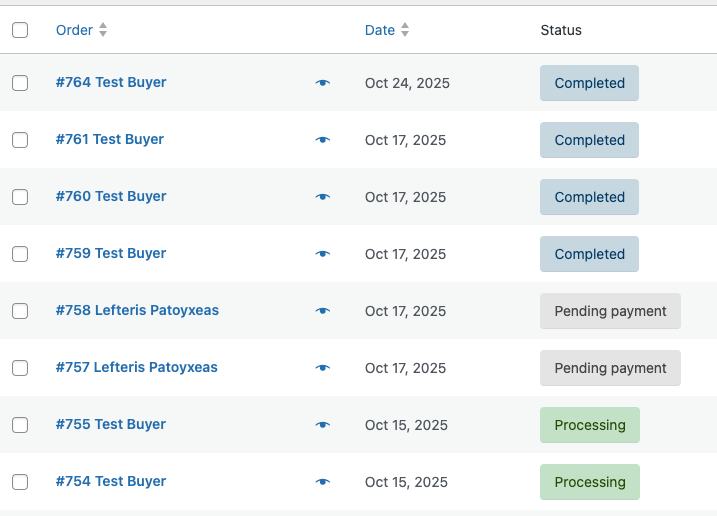
If the payments are successful, the order status in your WooCommerce backend will show as “Completed.”
This ensures your integration works properly.

7. View Transactions in the Coinsnap Dashboard

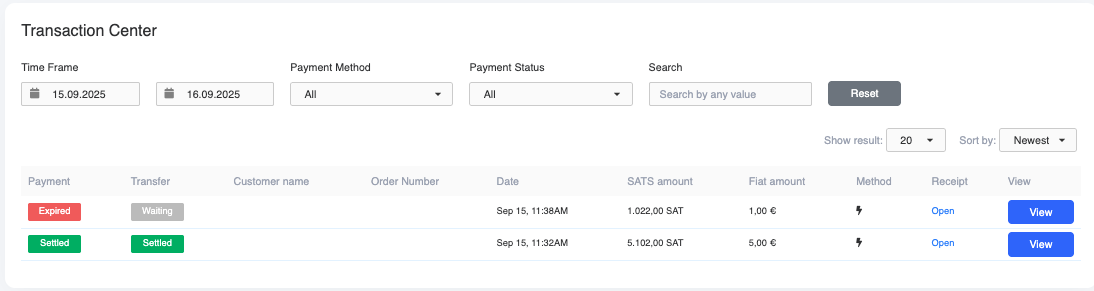
All transactions are listed in your Coinsnap Dashboard under Payments.

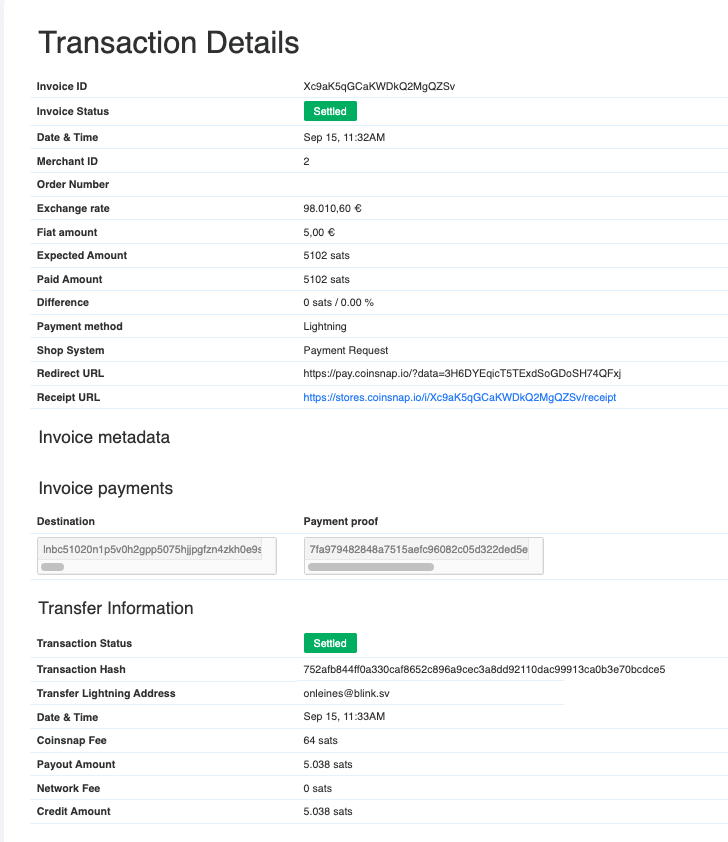
  • When the Payment status shows “Settled” in green, your customer has successfully paid.
  • When the Transfer status also shows “Settled,” the payment has been successfully credited to your wallet.

Click View to open detailed transaction information.

👉 Tip: Print out transaction details and attach them to the WooCommerce invoice for accurate accounting.

Conclusion: Why it makes sense to accept Bitcoin payments with WooCommerce

With Coinsnap, you can start accepting Bitcoin payments in your WooCommerce store in just a few simple steps — no intermediaries, no custody by Coinsnap, and direct settlement to your own wallet.

WooCommerce Bitcoin The Complete 2025 Guide

WooCommerce Bitcoin is a hot topic in 2025 because it solves three headaches at once: rising card fees, fraud/chargebacks, and cross-border friction.

With a Bitcoin (and especially Lightning) checkout, WooCommerce stores can offer near-instant payments at low cost, attract crypto-savvy buyers worldwide, and reduce exposure to chargebacks—all without rebuilding their stack.

In this complete 2025 guide to WooCommerce Bitcoin, you’ll learn how to add Bitcoin—and especially Lightning—to your store without coding, which plugins actually work (and why), how Lightning compares to on-chain for fees and speed, and what to know about compliance, accounting, and settlement. You’ll get a ranked shortlist of the best plugins, a decision matrix to choose fast, and a step-by-step setup using Coinsnap with an optional BTCPay Server path—plus FAQs and practical tips to go live smoothly.

Does WooCommerce support Bitcoin?

Not natively. WooCommerce needs a plugin to accept Bitcoin or Lightning. The good news: setup can be fast, cheap, and secure—especially with Lightning.

What Bitcoin payment plugins does WooCommerce recommend?

WooCommerce Bitcoin doesn’t come out of the box—but you can add it with extensions from the official Woo.com Marketplace, which currently highlights these four crypto plugins: Coinbase Commerce (a gateway that lets customers pay in crypto and plugs into your store in a few steps), DePay Payments (on-site Web3 wallet payments across multiple chains and tokens), Helio Pay (a multi-chain checkout with real-time payouts), and OpenNode (Bitcoin/Lightning payments with optional fiat settlement).

Those plugins come with a few limitations, though, that make merchants look for other, better suited solutions: Coinbase Commerce requires detailed KYB (know your business), and is on-chain only, so not good if you want to sell cheap products (below $1,000) fast. Also, merchants AND buyers need a Coinbase wallet – which reduces the customer base significantly. DePay is great, if you want to sell for EVM/Solana tokens, but it doesn’t do native Bitcoin or Lightning, so it’s a no go if you want t accept Bitcoin with WooCommerce. With Heliopay, you can accept Bitcoin on-chain, but Lightning is not supported – so again, no fast, cheap checkout for products below $1,000. Open Node offers solid Bitcoin/Lightning support, but it’s still a custodial gateway: you’ll open an account, complete KYB, and pay processor fees with settlement via the provider.

The good news: You don’t need a native WooCommerce Bitcoin solution

A handful of mature plugins (like Coinsnap or BTCPay Server) add BTC and Lightning alongside your existing methods, with options ranging from plug-and-play simplicity to self-hosted control and even automatic fiat settlement.

For most merchants, those solutions mean higher margins, faster checkouts, and a future-proof payment option that customers increasingly expect. We will present the four best Bitcoin-Lightning plugins for WooCommerce below.

Why add Bitcoin (and Lightning) to WooCommerce?

Bitcoin opens global checkout without card rails, cuts processing costs, and removes chargebacks. Lightning adds real-time settlement and typically sub-cent fees, which improve margins and customer experience—especially for everyday orders and digital goods.

Your options at a glance:

  • Lightning-ready, non-custodial: Coinsnap (plug-and-play; direct to your wallet, supports on-chain and Lightning, easy BTCPay Server integration, easy FIAT settlement with Bringin or DFX, easy accounting with Cointracking)
  • Self-hosted control: BTCPay Server (open source; zero platform fees; you run it)
  • Custodial with fiat settlement: CoinGate, BitPay (accept BTC/LN; settle to EUR/USD/GBP)

Tip: Most stores do best with a WooCommerce Bitcoin-Lightning-ready plugin that also offers optional on-chain for high-value carts!

Lightning vs on-chain (quick compare)

There are two types of Bitcoin payment: On-chain and Lightning. On-chain Bitcoin payments are recorded directly on the blockchain; they’re highly secure and auditable but settle more slowly (you usually wait for confirmations) and incur miner fees that rise with network congestion—great for higher-value, lower-frequency orders or final settlements.

The Lightning Network moves payments off-chain through pre-funded channels; transactions confirm in seconds with tiny fees, making it ideal for everyday commerce, micro-payments, and a fast checkout UX. Lightning payments ultimately anchor to the blockchain (channels are opened/closed on-chain), but most customer payments don’t touch the chain, which is why they’re so quick and cheap.

In practice, smart WooCommerce merchants enable both: Lightning by default for speed and costs, with on-chain as a fallback for large carts, customers who insist on it, or when channels/liquidity need adjustment.

  • Fees: Lightning is much cheaper than on-chain (no miner fee per payment).
  • Speed: Lightning takes a few seconds – on-chain transactions can take minutes.
  • UX: Tap/scan, paid—no waiting for confirmations!
  • When on-chain? Larger tickets (above $ 1,000), treasury moves, or when a customer requests it.

.

Best plugins for WooCommerce Bitcoin (2025 shortlist)

WooCommerce doesn’t ship Bitcoin out of the box, so the right plugin is what turns your store into a BTC (and Lightning) checkout that’s fast, low-fee, and secure.

In our blog post “The 10 best WooCommerce Bitcoin payment plugins (2025 guide)“, we rank the 10 best WooCommerce Bitcoin payment plugins—from Lightning-first, non-custodial options to custodial gateways with fiat settlement—and compare them on the things that matter: fees, custody, Lightning support, payout options, KYC/KYB, ease of setup, and support. Whether you want plug-and-play simplicity or self-hosted control, this shortlist shows exactly which plugin fits your store and how to get live quickly.

Learn all about the great plugins from Coinsnap, BTCPay Server, CoinGate, BitPay, NOWPayments, Blockonomics, Coinbase Commerce, CryptoPay, Helio Pay, DePay, and which one might be the best for you, here.

Here is a decision matrix for the 10 best WooCommerce Bitcoin payment plugins:

(click the image to download the Excel decision matrix for the 10 best WooCommerce Bitcoin payment plugins!)

The 4 best WooCommerce Bitcoin payment plugins for WooCommerce

These plugins are all available in the WordPress plugin repository, and support on-chain as well as Lightning.

1) Coinsnap for WooCommerce
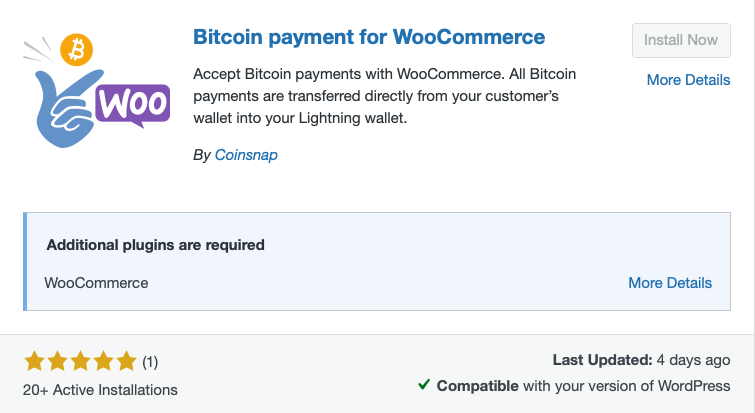
The Coinsnap WooCommerce Bitcoin payment plugin is Lightning-first and non-custodial: invoices are paid by scanning a QR code and funds are forwarded instantly to your own Lightning wallet. The WooCommerce setup is lightweight (store ID + API key), and even comes with a wizard to connect your own BTCPay Server if you prefer to self-host. Of course, it also enables on-chain payments for larger tickets.

Coinsnap positions itself for speed, privacy, and minimal onboarding friction, typically charging around 1% for processing. Ideal for merchants that want to accept Bitcoin payments with minimum effort, and without having to become serious “Bitcoiners”.

2) BTCPay Server

BTCPay Server was the first open source Lightning payment DIY solution that pioneered and revolutionized the Bitcoin payment landscape. It’s a self-hosted, open-source Lightning payment gateway, thus coming with no platform fees. You run the stack, keep keys, and can accept both on-chain Bitcoin and Lightning. The official “Greenfield” WooCommerce plugin and docs make integration straightforward, but you’ll own hosting, upgrades, and security.

Best for merchants with decent programming and technical skills that value sovereignty, auditability, and deep configurability over convenience.

3) CoinGate


A popular gateway that supports Bitcoin (on-chain and Lightning) and a wide set of altcoins; Lightning is enabled by default in its ecommerce plugins. Merchants can settle in crypto or in fiat (EUR/USD/GBP), but the WooCommerce module is maintained on GitHub (which makes it a bit more complicated for non-skilled merchants to integrate). Pricing is a flat 1% per processed payment.

Good blend of features for merchants who want LN + optional fiat settlement and are not afraid of Github.

4) BitPay


An enterprise-grade gateway with long track record, supporting Lightning since 2022. It offers robust business tooling, refunds, payouts, and broad compliance coverage. Pricing is tiered (1–2% + $0.25 per transaction depending on monthly volume).

Strong choice for regulated merchants that want fiat settlement and mature support.

For detailed information on the ranking and the defining characteristics of the plugins featured in this comparison, read The 10 Best WooCommerce Bitcoin Payment Plugins (2025 Guide)

How to accept Bitcoin on WooCommerce (no coding)

Adding Bitcoin to WooCommerce can be truly no-code when you pick the right plugin: install it directly from your WordPress plugin repository, connect it with your processor, enable it under WooCommerce → Settings → Payments, and you’re live in minutes.

With non-custodial, Lightning-first options (e.g., Coinsnap), there’s no KYB/KYC—you sign up with just an email and add your Lightning address, and payments settle directly to your wallet without a middleman. If you later want fiat settlement via a custodial gateway, KYB will apply; but for pure BTC/Lightning checkout, it’s plug-and-play with zero paperwork.

Here is how it works:

  1. Install a plugin (e.g., Coinsnap).
  2. Connect credentials (Store ID/API key or wallet).
  3. Enable in WooCommerce → Settings → Payments.
  4. Test order with a small Lightning payment.

.

1. Install Plugin from WordPress


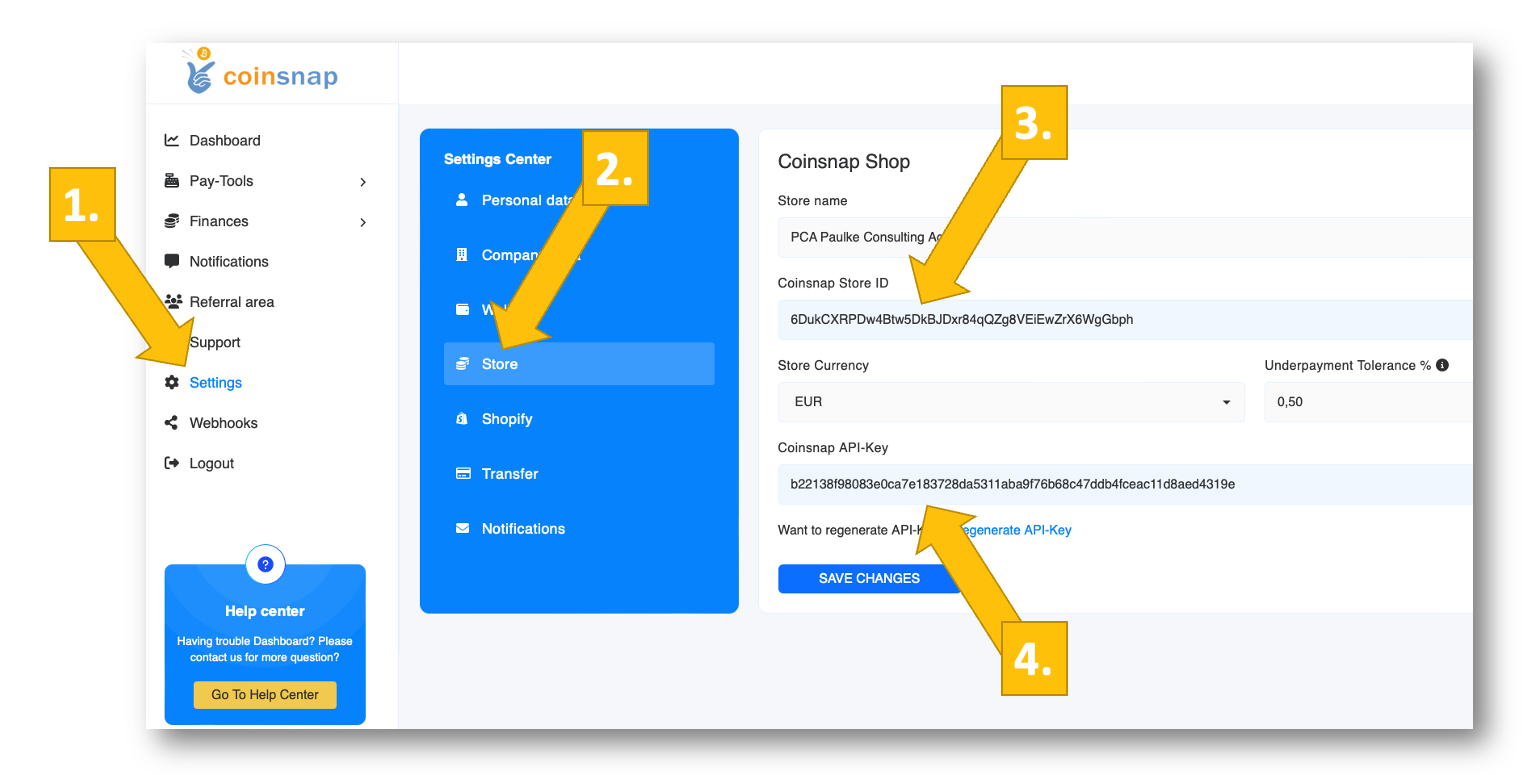
2. Connect credentials
 

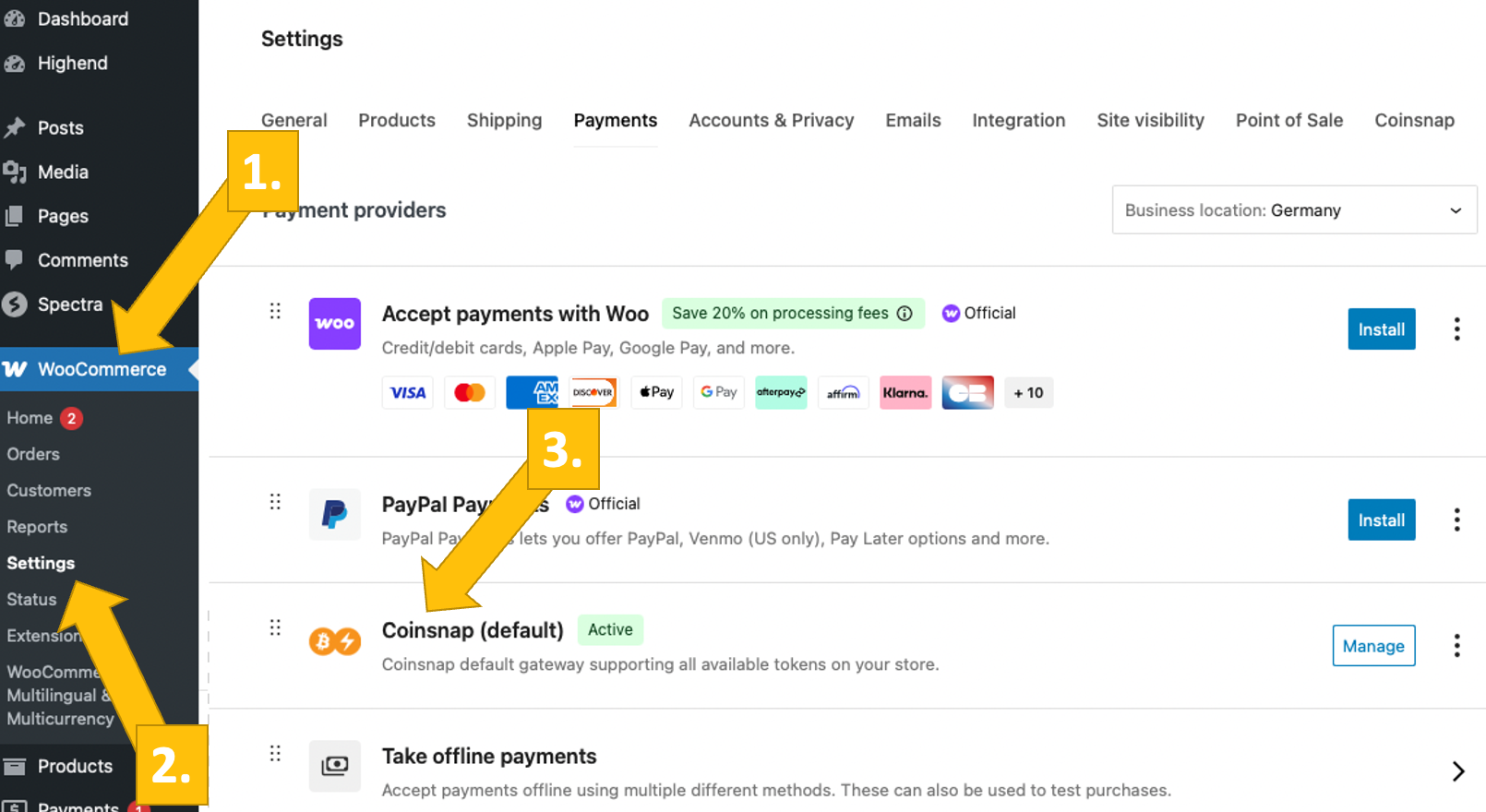
3. Enable in WooCommerce
 

4. Buy something in your store!
 

Click images to enlarge!

That’s as simple as it gets to accept Bitcoin in your Woo store – if you are ready to do it, see the step-by-step installation guide!

Compliance, accounting, and settlement – what to watch

When you add Bitcoin at checkout, compliance needs depend mainly on your custody model. If you use a custodial/fiat-settling gateway, expect KYB/KYC, basic AML/sanctions screening, and provider terms covering refunds and chargebacks; if you go non-custodial (funds straight to your BTC/Lightning wallet), you usually avoid provider onboarding—but you still must meet local rules on consumer protection, invoicing/VAT, and tax reporting. I.e., Coinsnap or BTCPay Server do not require any KYC/KYB – an email address and a Lightning wallet are all that‘s needed. If you choose Coingate, you will have to provide information on your business and your person.

Accurate accounting matters because revenue is recognized at the fair-value fiat price at payment time; so you should log the BTC amount, the exchange rate at checkout, order ID, and TXID/Lightning payment hash, then track any FX gains/losses if/when you convert to fiat, plus mirror refunds with the same data. Plugins like Coinsnap make accounting simple for you: In the dashboard you will find detailed info on any transactions, which you can export in various formats and forward to your accountant. To deal with exchange rates and FX gains/losses, you can easily integrate Coinsnap with CoinTracking, which provides such information in a form that is compliant with all european tax authorities.

For settlement, you can choose direct self-custody (Lightning and/or on-chain), automatic fiat payouts to a bank account via a processor, or a hybrid (e.g., Lightning for everyday orders, on-chain for high-value carts, with periodic manual or automatic conversion). I.e., with Coinsnap you can receive Bitcoin payments directly in your Lightning wallet, your BTCPay Server, or on-chain. If you prefer real time fiat conversion, open a Bringin account and entert he Lightning wallet address in your Coinsnap – and all your payments will be credited to your Fiat account in real time.

  • KYC: Custodial gateways require KYB; non-custodial generally don’t.
  • Fiat settlement: If you want daily EUR/USD payouts, choose CoinGate or BitPay, or use Coinsnap with a Bringin Lightning wallet.
  • Bookkeeping: Export CSVs, tag BTC/LN orders, and reconcile regularly.

FAQs – what you need to know about WooCommerce Bitcoin and Lightning

1) Does WooCommerce support Bitcoin natively?

No. WooCommerce doesn’t include Bitcoin out of the box—you enable BTC (and Lightning) via third-party plugins like Coinsnap or BTCPay Server.

2) What’s the fastest way to get WooCommerce Bitcoin payment  without coding?

Install a compatible plugin, enable it in WooCommerce → Settings → Payments, paste the wallet/API details, and run a test order. With plugins like Coinsnap merchants can add Bitcoin checkout to their WooCommerce in minutes.

3) What’s the difference between on-chain WooCommerce Bitcoin payments and WooCommerce Lightning payments?

On-chain payments settle on the blockchain (slower, miner fees, great for high-value orders). Lightning routes off-chain through channels (seconds, tiny fees) and is ideal for everyday commerce.

4) Which is cheaper: on-chain or Lightning?

Lightning is typically far cheaper (fractions of a cent) and faster; on-chain includes miner fees that vary with network congestion.

5) Do I need KYC/KYB to accept Bitcoin?

For non-custodial plugins (funds go straight to your wallet), usually no. For custodial gateways and fiat settlement, expect KYB/KYC as part of AML compliance.

6) Can I settle sales to my bank account in EUR/USD/GBP?

Yes—choose a provider that offers fiat settlement. If you prefer self-custody, you can keep BTC or convert later via your own exchange workflow.

7) How do I handle Bitcoin price volatility at checkout?

Use rate-locking (most plugins do this) to quote a fixed BTC amount for a limited time window, then record the fiat value at the moment of payment for accounting.

8) Are Bitcoin payments subject to chargebacks?

No. Bitcoin/Lightning payments are push-transactions; there are no card-style chargebacks. You can still issue refunds per your policy.

9) How do refunds work with Bitcoin or Lightning?

You send a new payment back to the buyer’s address/invoice. Some gateways streamline this with refund tools; otherwise you handle it manually (record TXIDs/payment hashes).

10) What data should I record for accounting/taxes?

Store the BTC amount, fiat value at payment time, exchange rate, order ID, and TXID/Lightning payment hash. Reconcile exports (CSV) to your wallet/bank monthly.

11) Will offering WooCommerce Bitcoin payment break my existing checkout?

No. It appears as an additional method alongside cards/PayPal. You can keep all other gateways active.

12) Can I accept both Lightning and on-chain in one store?

Yes. Many plugins let you enable both—Lightning as default for speed/costs, on-chain for large tickets or customer preference.

13) Is it secure to offer WooCommerce Bitcoin payment?

Yes—use reputable plugins, HTTPS, and secure wallet practices (hardware wallet, backups, access controls). Payments are final once received.

14) Can I use WooCommerce Bitcoin payment for in-person sales, too?

Yes. Some providers like Coinsnap include Web-PoS/QR flows so you can accept Lightning in store or at events using a phone or tablet.

15) Do Bitcoin payments help conversion rates?

They can—especially for international buyers, privacy-minded customers, or digital goods/micro-payments where Lightning’s speed and fees shine.

16) How can I test Bitcoin checkout safely?

Most plugins support test modes or small live payments. For Lightning, send tiny invoices; for on-chain, use small amounts and confirm order status end-to-end.

Next steps to start accepting WooCommerce Bitcoin payments

Read our analysis of the 10 best WooCommerce Bitcoin payment plugins, and get all the information to make the best choice!

Read the Coinsnap for WooCommerce installation guide and see how easy it is to accept WooCommerce Bitcoin payments in your store – even with your own BTCPay Server!

Start now and register your Coinsnap account with just your email and your Lightning wallet address – and you can get started by just installing the plugin in your WordPress!

How-To: Set up WooCommerce Bitcoin Payment with Coinsnap in 10 Minutes

Here’s what you’ll get in this 10-minute guide: a quick look at the WooCommerce-supported Bitcoin plugin options vs. the wider WordPress repository, a plain-English overview of Coinsnap for WooCommerce (Lightning + on-chain, no KYC/KYB for BTC/LN payouts, BTCPay Server wizard, optional fiat off-ramp via Bringin/DFX), and a fast, no-code setup you can follow step by step—from install to your first €1 Lightning test.

We’ll also cover smart defaults (rate-locking, on-chain fallback), basic compliance/accounting pointers, and quick fixes for common pitfalls so you can go live with confidence today.

After you’ve read this article, you certainly will know how to add Bitcoin to WooCommerce and how to setup WooCommerce Bitcoin in 10 minutes!
This is a very detailed How-To: Set up WooCommerce Bitcoin Payment with Coinsnap in 10 Minutes – we cover not only the simple 10 minutes setup, but many related aspects to give you the full view of all aspects of setting up WooCommerce Bitcoin payment with Lightning. So reading the entire article might take you twice as long as just installing WooCommerce Bitcoin payment with Coinsnap!
If you can’t wait and just want to get started and online with your WooCommerce Bitcoin payments, just skip the basics and go right to the quick 10 minutes installation guide!

Table of contents  Show 

Why WooCommerce Lightning payments in 2025

Card fees negatively impact your margin, fraud and chargebacks are costly, and cross-border payments still create friction.

Adding Bitcoin Lightning to WooCommerce gives you (near-) instant settlement, tiny fees, and a more private, global checkout.

The best part: you don’t need to code or rebuild your store–with the right plugin, you will be live in minutes!

Woo Marketplace vs WordPress Plugins (Bitcoin Options)

WooCommerce doesn’t ship Bitcoin out of the box. The Woo.com Marketplace keeps a small, curated set of crypto extensions (e.g., Coinbase Commerce, DePay, Helio Pay, OpenNode). That curation is helpful for quality and support, but it also limits choice—especially if you want Lightning or non-custodial settlement:

Coinbase Commerce offers Lightning payment, but only if merchant AND customer own a Coinbase wallet–which reduces the customer base significantly. The other featured plugins do not even offer Lightning payment–so for merchants addressing Bitcoin owners they are completely useless.

Beyond Woo.com, the WordPress.org plugin directory and GitHub offer a broader selection, including many Lightning-first and self-hosted options. For most stores that want low fees, fast UX, and independence, this is where the best fits live.

If you are interested, here you will find a comprehensive comparison of the 10 best WooCommerce Bitcoin payment plugins 2025.

Why Choose Coinsnap for WooCommerce (Lightning/on-chain, No KYC/KYB)

Coinsnap is a non-custodial, Lightning-first gateway (that supports on-chain as well) for WooCommerce that makes it super-easy to add WooCommerce Lightning payments to your payment methods and checkout, without interfering with your other payment methods.

Coinsnap for WooCommerce comes with a full stack of great features that make it simple and safe for every merchant to accept Bitcoin on WooCommerce–without any coding skills:

Full Lightning

Use Lightning for simple transactions, fast transfer of funds and minimal fees.

on-chain-ready

Your buyers choose – during checkout they can optionally send their Bitcoin on-chain  (on-Chain payments will automatically be credited to your Lightning wallet).

Direct credit to your Lightning wallet

With Coinsnap, each payment is credited in real time directly to the merchant’s own Lightning wallet—non-custodial, with no funds held by a processor.

BTCPay Server wizard

Prefer self-hosting? Pair Coinsnap with your own BTCPay Server in a guided flow.

No KYC/KYB (for BTC/LN payouts)

Sign up with just an email and your Lightning address; funds settle directly to your wallet.

Fast, no-code install

Add the plugin, paste your credentials, enable—it’s that simple.

Easy fiat off-ramp

If you want automatic fiat settlement, connect partners like Bringin or DFX (their onboarding may apply).

Bottom line: Coinsnap gives you the quickest path to a Lightning-ready checkout, while still letting you add on-chain, self-hosting (via BTCPay), and optional fiat settlement when you need it.

Step-by-Step: How to add Bitcoin to WooCommerce with Coinsnap in 10 Minutes

In about 10 minutes—and without any coding—you’ll install Coinsnap, connect your Lightning address, switch on Bitcoin/Lightning in WooCommerce, and run a quick €1 test payment to confirm everything works.

Here is how it works:

What you need (checklist)

  • A live WordPress + WooCommerce store with HTTPS (SSL).
  • Admin access to WordPress.
  • Lightning wallet or address (for example, you@lightning.address).
  • A valid email (to create your Coinsnap account).
  • 10 minutes of quiet time ☕️

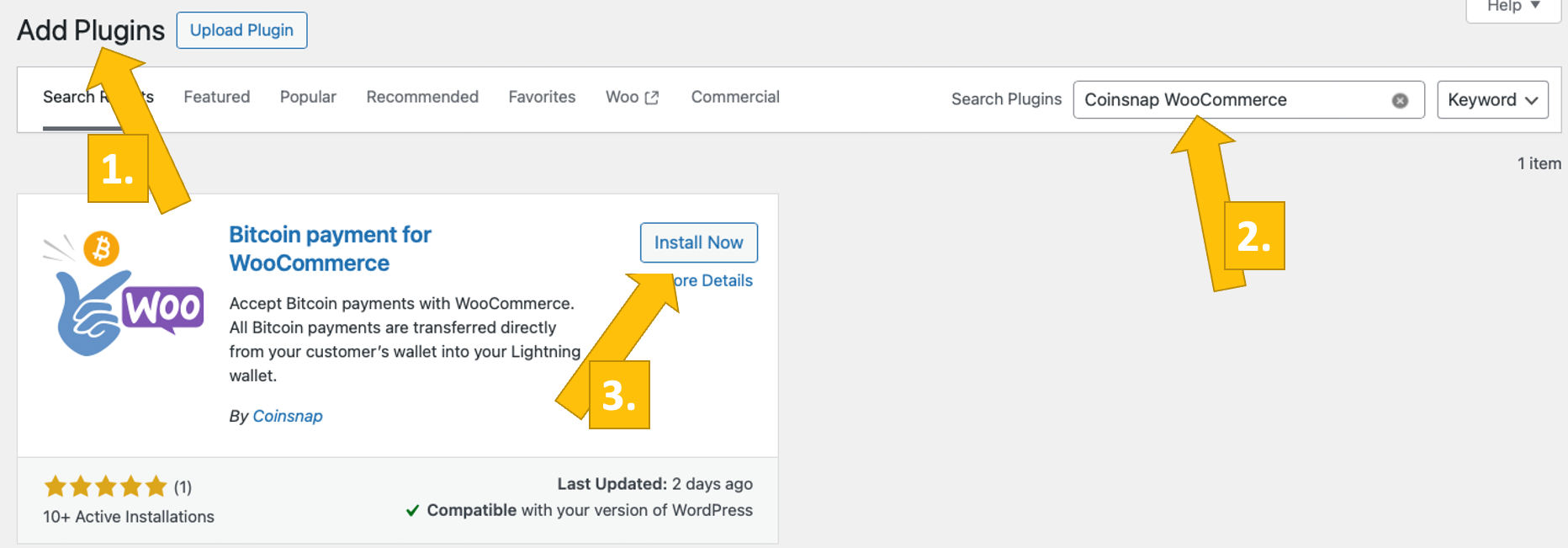
1) Install the Coinsnap plugin (2 minutes)

  1. In WordPress, go to Plugins → Add New.
  2. Search for “Coinsnap”.
  3. Click install, then activate.

That’s all–the plugin is now installed and active. Now you need to connect the plugin to your Coinsnap account and enable it in WordPress.

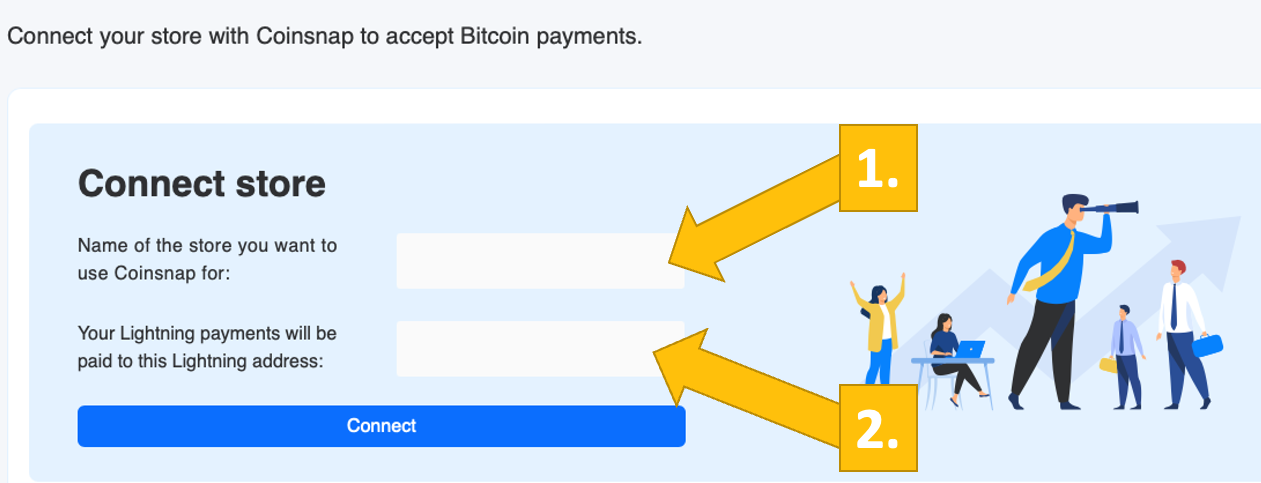
2) Create your Coinsnap account & connect your Lightning wallet (3 minutes)

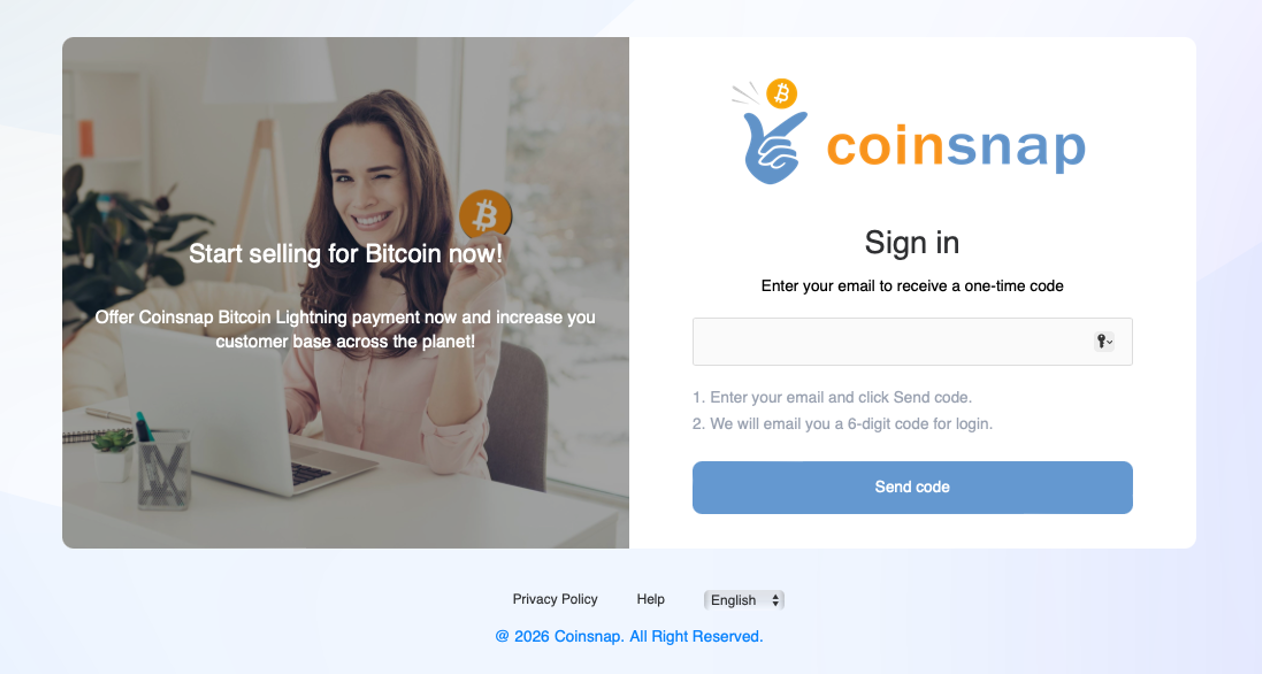
  1. Open Coinsnap and sign up with your email.
  2. Add a store name [1] and your Lightning wallet/address [2]
  3. Copy your Store ID and API Key (see second image) and paste these into the Coinsnap plugin.

Privacy win: Because settlement is non-custodial, there’s no KYB/KYC to start accepting BTC/LN to your own wallet.

All you need is a valid email (to receive your login link) and a Lightning wallet. And, you must enter a name for your store (which will show in statements, payment confirmations etc.).

3) Enable Coinsnap in WooCommerce (2 minutes)

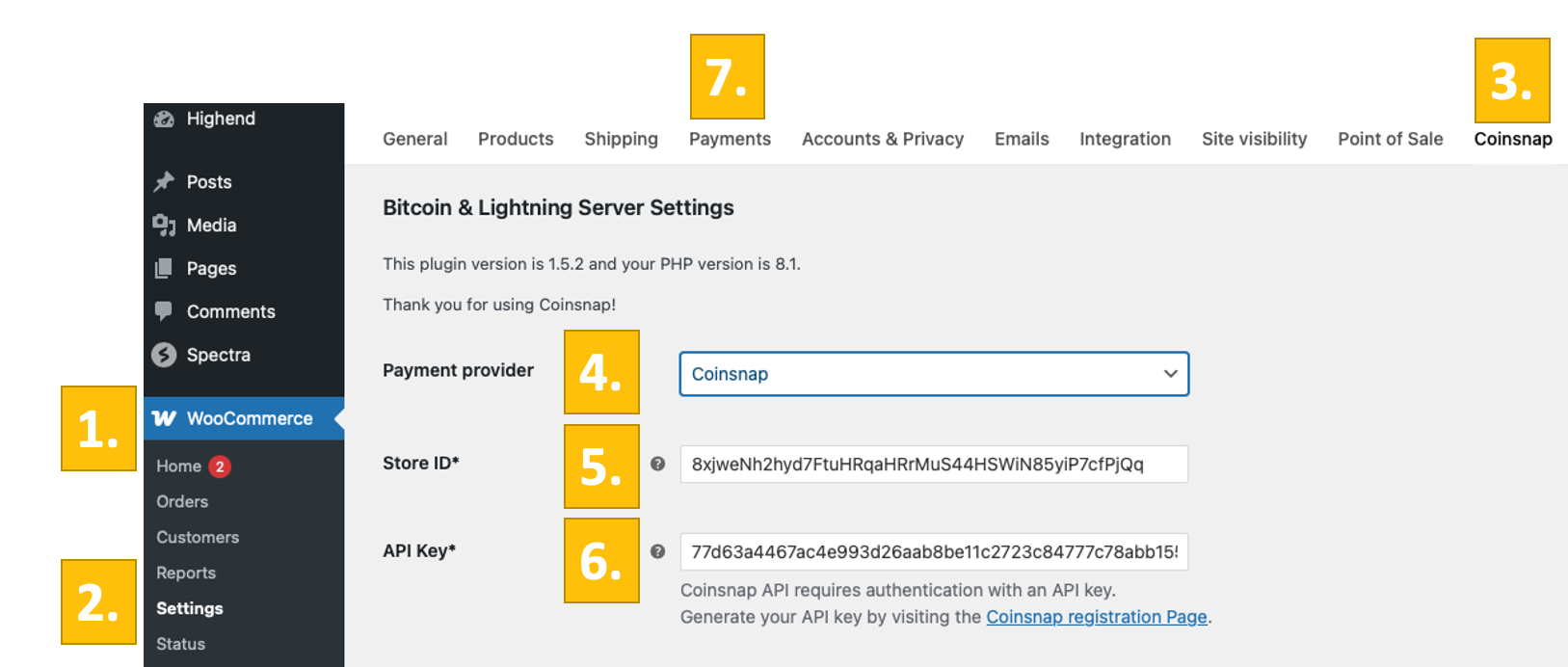
  1. In WordPress, go to WooCommerce [1] → Settings [2] → Coinsnap [3].
  2. Choose Coinsnap as your payment provider [4], and paste your Store ID [5] and API Key [6].
  3. Then go to Payments [7] where you Enable Coinsnap and click save.

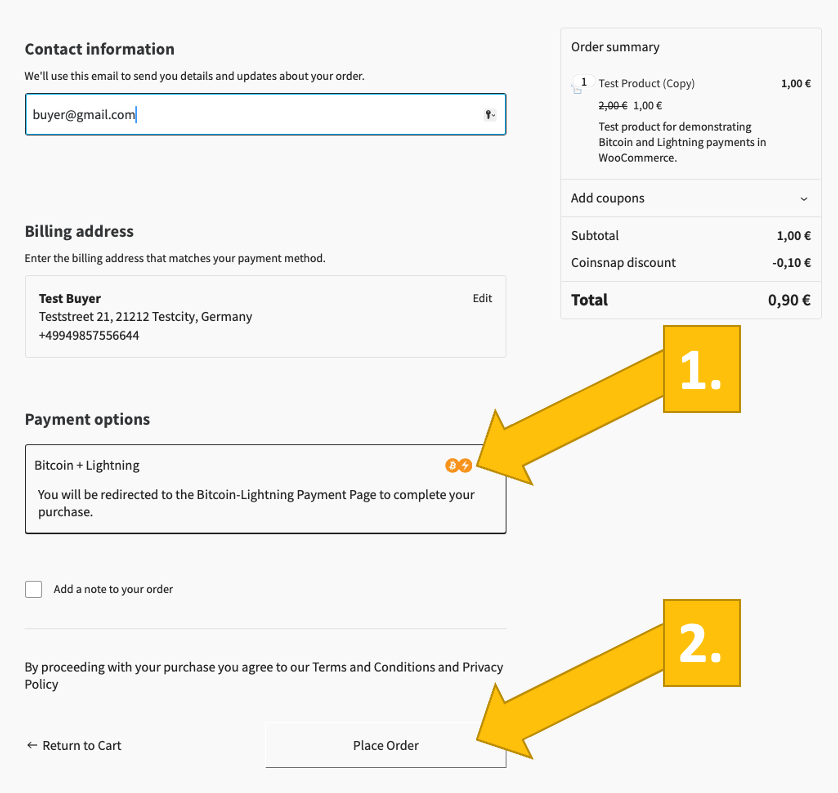
4) Test a real payment (2 minutes)

  1. Create a test product priced low (e.g., €1).
  2. After you’ve chosen Bitcoin/Lightning [2] in the first step of your checkout, now Check out [2].
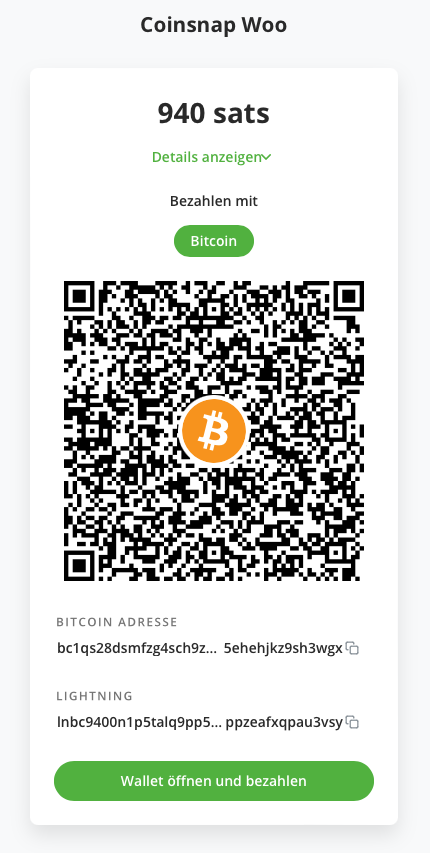
  3. Scan the QR with your wallet (ideally not the one you use to receive payments with Coinsnap) and send the payment.
  4. Confirm the order status updates in WooCommerce and that Coinsnap shows the transaction details.

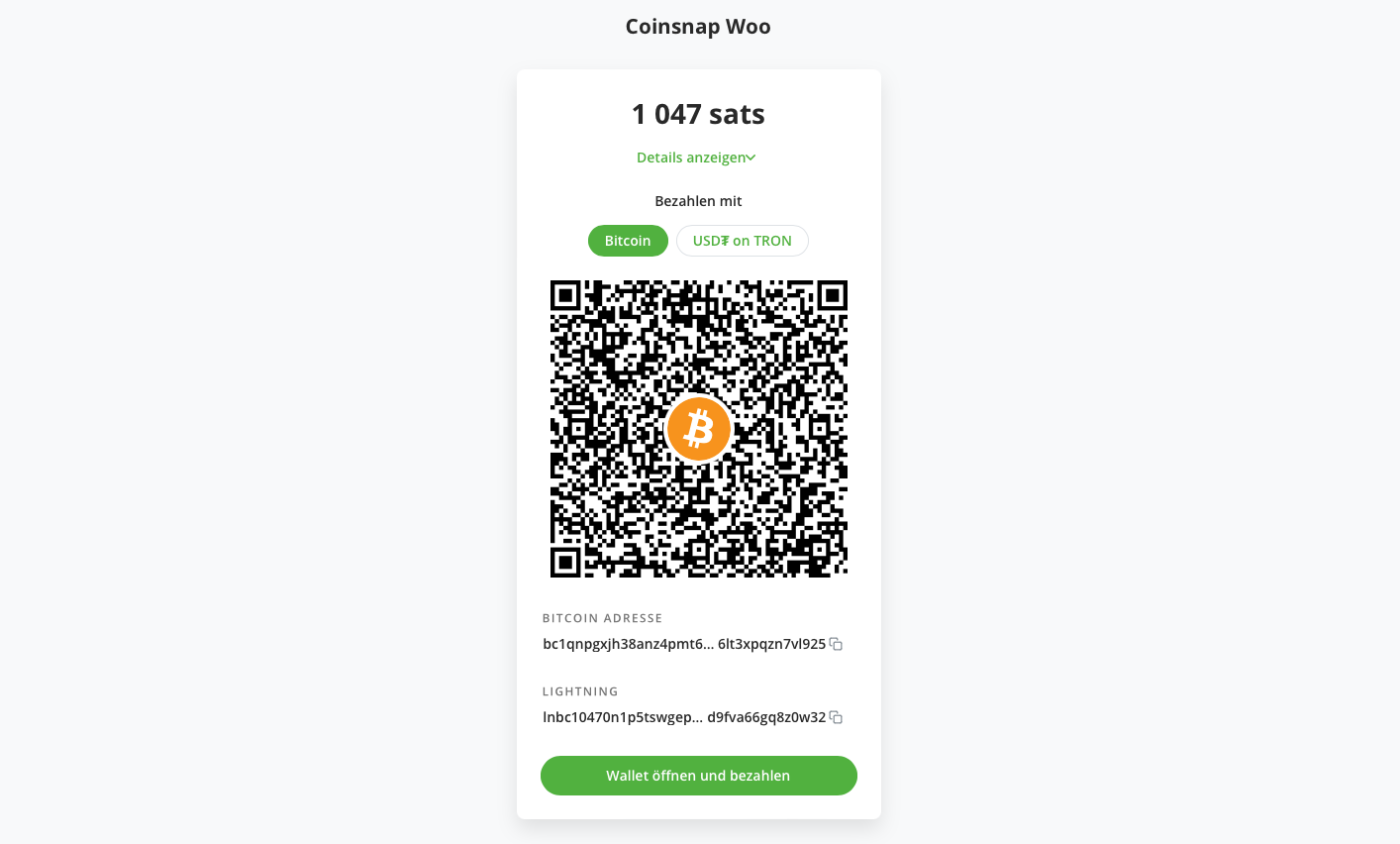
You’ll see the QR code now (second image) – just scan it with your Lightning wallet and conform the payment. (If you want to test on-chain payments, send the sats to the on-chain address listed beneath the QR code.)

If something’s off: Re-check the API key, your store URL, and that your wallet can pay Lightning invoices.

Optional: BTCPay Server & Fiat Settlement (5–10 minutes more, any time)

Merchants that value full sovereignty over their Bitcoin Lightning payment process should choose the BTCPay Server option that Coinsnap provides: If you connect your BTCPay Server to your WooCommerce via Coinsnap, you self-custody your funds (no third party holds your Bitcoin), pay zero platform fees, and control data, uptime, and compliance policies end-to-end. BTCPay Server supports both Lightning and on-chain, and lets you customize checkout, reporting, and routing—ideal for privacy-minded or high-volume stores that prefer no KYB, no vendor lock-in, and a payment stack they can audit and extend themselves, if they have the skills (NOTE: it’s not for beginners, coding skills and Lightning expertise required!). Learn more about BTCPay Server with Coinsnap

Merchants who want the reach and low fees of Bitcoin without holding BTC on their books—should opt for immediate fiat crediting that auto-converts Lightning/on-chain payments into EUR at the moment of sale and pays out to a personal SEPA bank account. This removes price volatility, simplifies accounting and VAT (no crypto treasury, no FX gains/losses tracking), keeps cash flow predictable for payroll and suppliers, and still preserves Bitcoin’s no-chargeback advantage. An elegant and easy to use solution for such merchants is to use Coinsnap with Bringin or DFX to off-ramp Lightning in real time. Learn more about Coinsnap + Bringin

A) Use the BTCPay Server wizard

If you’re a sovereignty fan, pair Coinsnap with your own BTCPay Server:

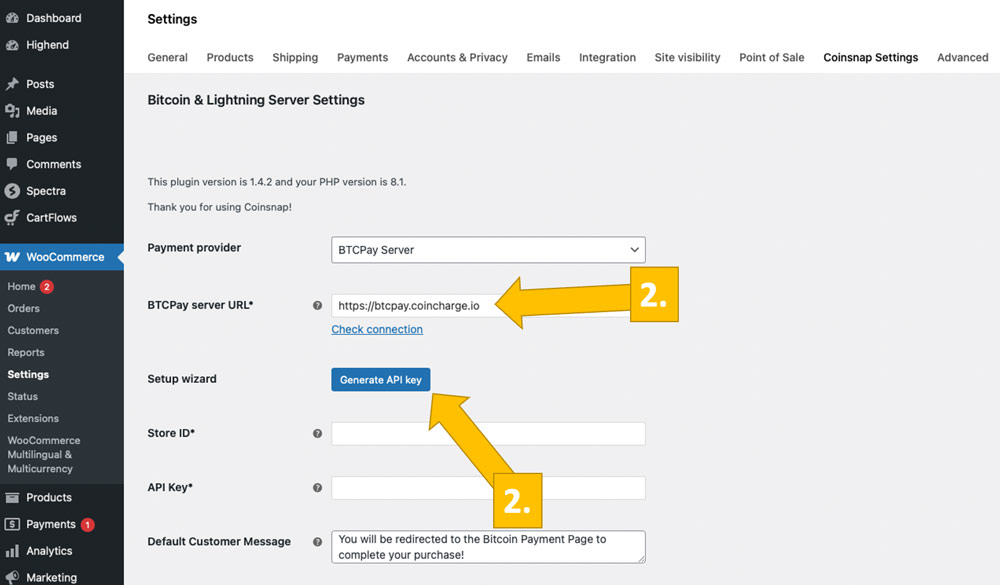
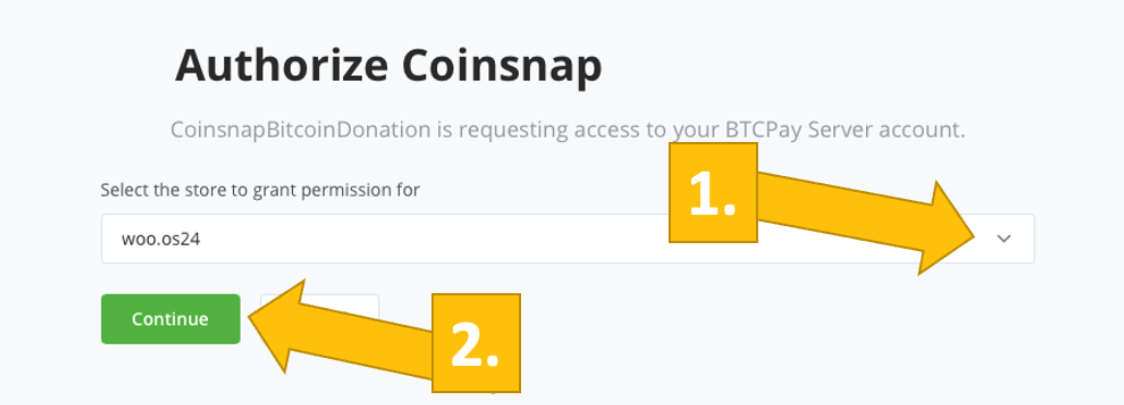
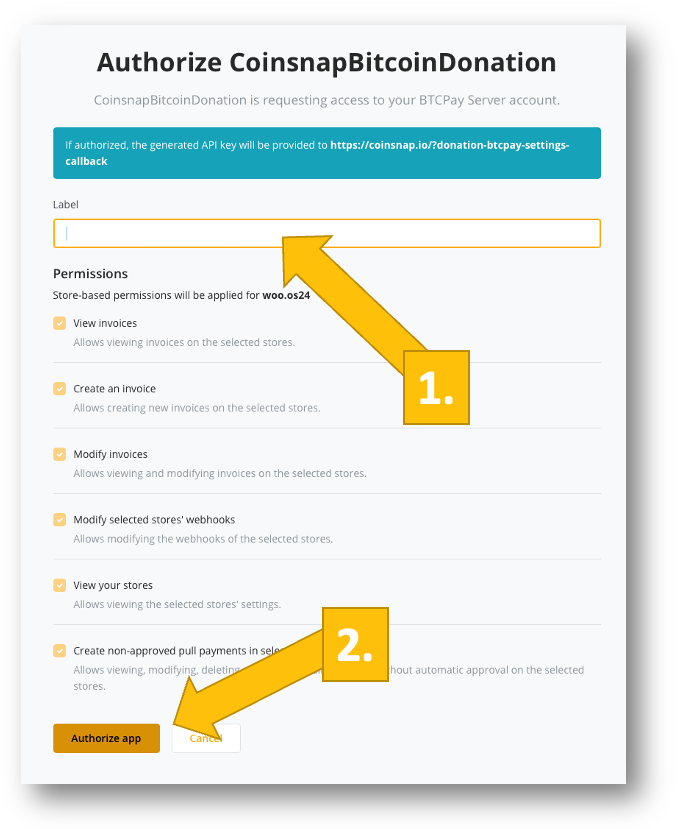
  • Choose BTCPay Server in the gateway choice on the top of the Coinsnap tab in WooCommerce, and enter your BTCPay URL [1] and click Generate API Key [2]
  • then confirm (twice), as requested by your BTCPay Server [see images 2 and 3]
  • Save and test.

NOTE: you need to be logged in to your BTCPay Server before you start the process.

If done, you’ll enjoy full control while retaining Coinsnap’s smooth WooCommerce integration. Also, you don’t even have to register a Coinsnap account – you preserve full autonomy!

B) Enable automatic fiat settlement (Bringin)

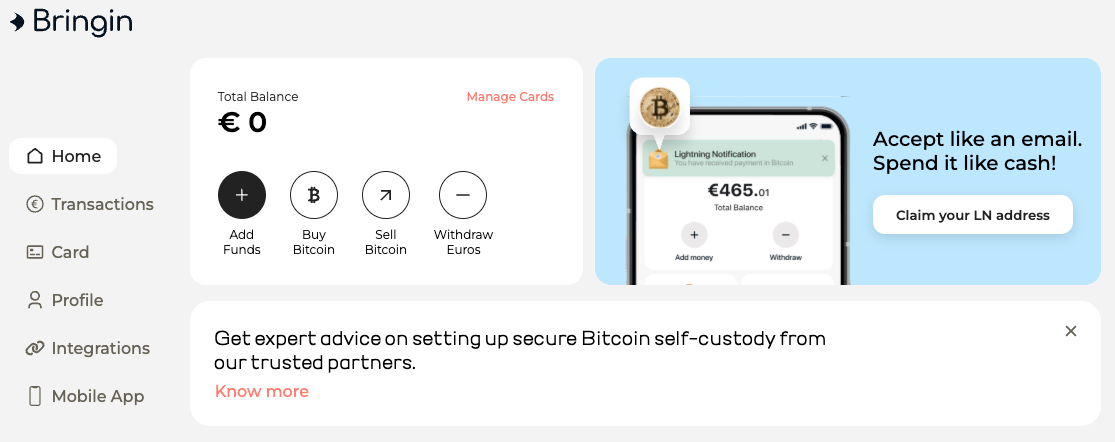
Bringin is a Bitcoin-to-Euro service that gives you a personal Lightning address and a IBAN (EU bank account in your name). When you plug that Lightning address into Coinsnap, every Lightning payment from your WooCommerce checkout is auto-converted to EUR in real time and credited to your IBAN—no technical setup beyond pasting the address.

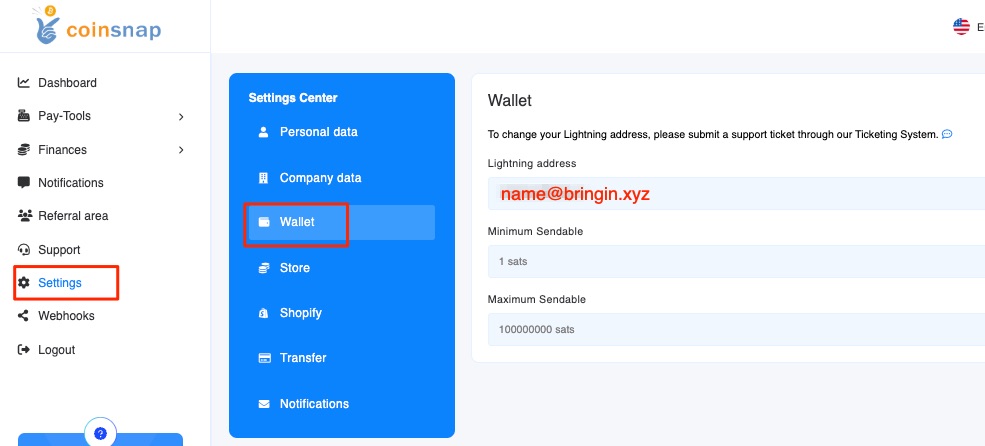
  • Create a Bringin account here (KYC: ID + recent utility bill) and claim your Lightning address (e.g., storename@bringin.xyz).
  • In your Coinsnap account → Settings → Wallet, paste that Bringin Lightning address.

Customers still pay with Bitcoin/Lightning at checkout, but the funds are now auto-converted to EUR and credited to your IBAN. You can transfer EUR to your bank account on demand.

With Coinsnap and Bringin you keep the reach and low-fee benefits of Bitcoin, but your accounting stays simple (euro in, euro out), volatility is removed, and funds can be moved to your regular bank account whenever you like.

If you need a more detailed, step-by-step guide on how to integrate Bringin with Coinsnap, look here!

TIP: If you are interested in an alternative, check out DFX, a swiss Bitcoin broker that offers and support a simple integration with Coinsnap: https://coinsnap.io/payout-to-bank-account-with-dfx/

Configuration best practices

The best Bitcoin plugins like Coinsnap are built around most merchant’s needs—so, for example, with Coinsnap, most settings work out of the box; just sanity-check a few smart defaults and you’re set.

Pricing & rate locking

  • Keep currency as your store’s default (EUR); the plugin handles the conversion amount displayed in Sats (Satoshis).
  • Don’t worry about rate locking so the BTC amount holds for a short window – Coinsnap comes with a pre-set 10–15 minutes rate lock.

Refunds (no chargebacks)

  • Bitcoin/Lightning are push payments; there are no card-style chargebacks.
  • When you issue a refund, you send a new payment to the buyer’s address/invoice and save the payment record in the wallet you used for the refund.

Fraud & risk

  • Because the customer initiates payment from their wallet, stolen card scenarios don’t apply.
  • Keep your normal store policies (returns, warranties) and publish them clearly.

When issuing refunds, never refund the exact original Bitcoin amount, but always refund the euro equivalent at the time of payment.

If a customer has purchased something for €50 and paid in Bitcoin, and you refund this amount 14 days later, you refund the amount of sats that corresponds to the market value at the time of the refund!

Compliance, accounting, and settlement: what matters

Before you flip the switch, get the basics right: compliance (your custody model determines whether KYB/KYC applies and which consumer/tax rules you must follow), accounting (log BTC amount, fiat value at payment time, exchange rate, and TXID/payment hash for clean books), and settlement choices (self-custody BTC/LN, automatic fiat payouts, or a hybrid).

The next section shows you what you should make your mind up about before you go live—and why it matters:

Compliance:

  • Non-custodial (Coinsnap to your wallet): generally no KYB/KYC; still follow local tax and consumer rules.
  • Custodial/fiat settlement (via partners): expect KYB/KYC and provider terms.

Accounting:

If you want to better understand the requirements for clean tax reports, read this article: https://coinsnap.io/accounting-and-tax-if-you-accept-bitcoin-payments-in-your-online-store/

Anyway, what you should know is:

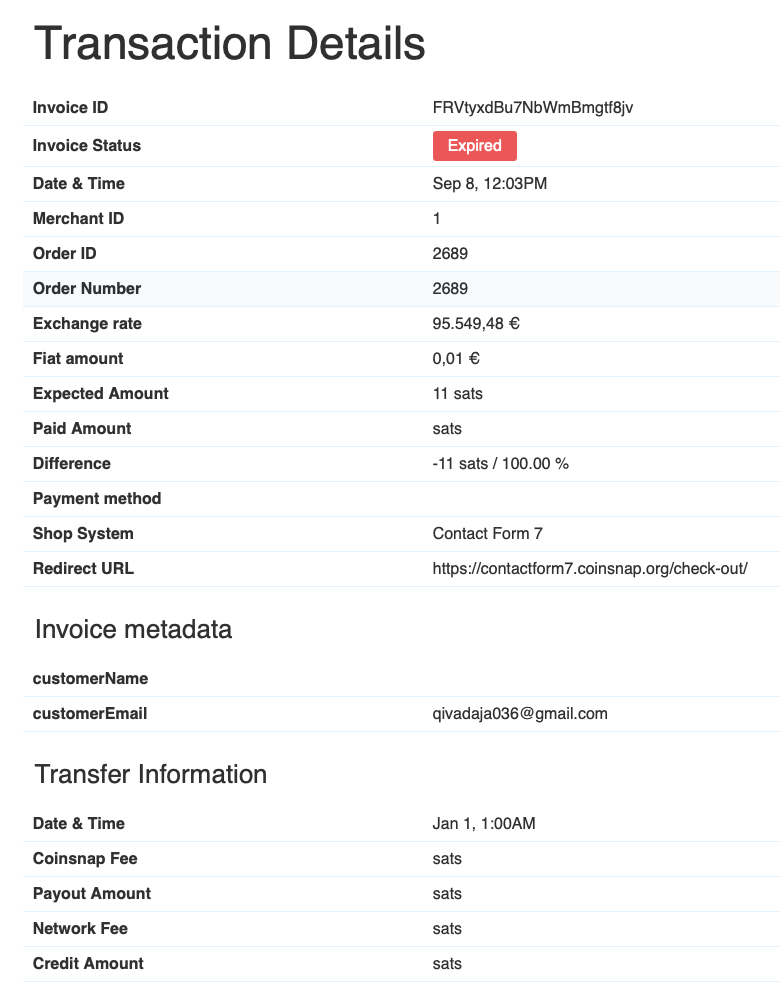
  • In your Coinsnap dashboard you’ll find detailed records of all transactions, featuring BTC amountfiat value at payment timeexchange rateinvoice and order IDsorder number, and customer email.
  • Export your financial statement CSV from Coinsnap regularly and reconcile with your wallet and accounting system.
  • If you convert to fiat later, track gains/losses between payment time and conversion.

If you plan to hold the BTC you receive, connecting Coinsnap to CoinTracking automates transaction imports, cost basis and gains/losses tracking, and produces tax-ready reports—minimizing bookkeeping effort and reducing risk with your local tax authorities. Learn more about CoinTracking for TAX compliance here: https://coinsnap.io/blog/cointracking-integrates-coinsnap/

Settlement choices:

How your Bitcoin revenue lands in your books is up to you—pick the settlement path that fits your risk tolerancecash-flow needs, and operational effort:

  • Direct self-custody (Lightning, on-chain),
  • Automatic fiat payouts (Bringin / DFX), or
  • Hybrid (Lightning default; on-chain for large tickets; periodic conversion).

Troubleshooting: quick fixes

With mature, well-tested plugins, troubleshooting is rarely needed—and when it is, it often requires backend checks best handled by the provider; top solutions like Coinsnap include a support tab right in your dashboard so their tech team can quickly investigate and resolve issues.

  • Payment received, order not updated: There might be issues with webhook/API credentials or that your site is blocking callbacks (security plugins, firewalls). That’s nothing you can fix by yourself–contact your support from your dashboard and write them a ticket. They will look into it and get back to you quickly.
  • Customer paid wrong amount (on-chain): Use rate-locked invoices and show clear countdown; encourage Lightning for speed/precision.
  • Duplicate pending orders: Since you do not know what caused the issues that prevented the processing of a payment, you can only try to contact the buyer via the email that you find in your transaction report in the dashboard.

Operations playbook (make it stick)

If you want smoother flows, fewer support hiccups, and higher conversion—especially from international, privacy-minded buyers—there are some proven tricks you should think about or implement.

By standardizing team steps (how to confirm payments, refund cleanly, reconcile weekly) and optimizing touchpoints (clear “Pay with Bitcoin/Lightning” cues, smart defaults, simple help links), you reduce friction and build trust—so more shoppers choose BTC and more of those payments succeed on the first try.

Here is what most successful Bitcoin merchants would recommend:

  • Train support: Teach what a successful BTC/LN payment looks like, how to confirm, and how to process refunds (create a blog post for that and put a link into your checkout).
  • Promote the option: Add “Pay with Bitcoin/Lightning” badges on product pages and at checkout; mention instant confirmation.
  • If you can, offer a small discount on Bitcoin payments (i.e. 5%)–everybody loves a discount (and you save half the cost of this discount alone on credit card fees, not counting elimination of chargebacks and preventing fraud)!
  • Offer both rails: Lightning by default, on-chain for high-value carts or customer request.
  • Reconcile weekly: Export Coinsnap CSV, match to WooCommerce orders and wallet transactions.

Lightning vs. on-chain (in practice)

Understanding the difference between Lightning and on-chain matters because it directly affects your fees, speed, and checkout experience—and therefore your margins and conversion rate. It also determines how you account and settle (instant LN payouts vs. confirmed on-chain transfers), which defaults to set in WooCommerce, and when to offer a fallback so payments don’t fail on busy days.

  • Fees: Lightning payments usually cost fractions of a cent because there’s no per-payment miner fee. On-chain payments include a miner fee that can rise with network congestion, so they’re better for fewer, higher-value transactions.
  • Speed: Lightning settles in seconds and flips the order to “paid” immediately. On-chain typically needs 1–3 confirmations (often 10–30 minutes), which can delay, or in a few cases even prevent fulfillment.
  • Checkout experience: Lightning is “scan and pay” with a countdown timer—fast and simple. On-chain often means copying an address/amount, with more risk of under/overpay.
  • Reliability: Lightning needs channel liquidity; good providers manage this. Keep on-chain enabled as a safe fallback.
  • When to use which: Default to Lightning for everyday and mid-sized orders or digital goods; offer on-chain for large tickets, treasury moves, or customers who prefer it.

Most merchants run Lightning first. If you have regular baskets with a value of more than $1.000, keep on-chain available as a fallback.

Mini FAQ – just to see if you understand it all

Does WooCommerce support Bitcoin natively?

No. You add BTC/LN with a plugin like Coinsnap (or self-host with BTCPay Server).

Do I need KYC/KYB?

Not for non-custodial BTC/LN payouts. Fiat settlement partners typically require it.

Can I get paid in euros automatically?

Yes—connect Bringin or DFX for automatic off-ramp to fiat (their onboarding applies).

Can I really get Bitcoin payment for WooCommerce in 10 minutes?

With mature plugins like Coinsnap you definitely can install, connect, and test your new WooCommerce Bitcoin payment in that window; allow extra time for design tweaks or advanced options.

Your 10-minute launch plan (recap)

  1. Install Coinsnap
  2. Create account (email) & add Lightning address
  3. Paste Store ID & API key in WooCommerce
  4. Enable Lightning (on-chain optional)
  5. Test a €1 order
  6. Go live.

Final thoughts on how add Bitcoin to WooCommerce in 10 minutes

If you want a fastercheaper, and more resilient checkout, Lightning is the new default—and Coinsnap is the easiest way to bring it to WooCommerce. Start with Lightning in minutes, and plug in Bringin/DFX for fiat settlement when needed. Connect your BTCPay Server if you want sovereignty. That’s modern payments—without the headaches.

Ready to setup WooCommerce Bitcoin in 10 minutes?

Accept Bitcoin Payments with WooCommerce

Accept Bitcoin Payments with WooCommerce

How to enable Bitcoin payments in your WooCommerce store – step-by-step guide, best plugins & tips!

Bitcoin has long been more than just an investment – more and more online merchants are offering Bitcoin as a payment method in order to reach new customer groups and stand out from the competition.

WooCommerce is the world’s leading eCommerce plugin for WordPress, making it easy and flexible to create online stores. The open source software offers a wide range of customization options, a large selection of extensions and intuitive operation.

With over 6 million active installations, WooCommerce is one of the most popular e-commerce solutions and is used by everything from small start-ups to large brands. Thanks to its flexibility, it is suitable for selling physical and digital products, subscriptions, services and even cryptocurrencies.

For these 6 million WooCommerce stores, it is now easier than ever to accept Bitcoin payments with WooCommerce — thanks to easy-to-install plugins based on Lightning technology.

But why should you accept Bitcoin payment with WooCommerce? What are the benefits for merchants and customers? And how do you set up the Bitcoin payment option in just a few minutes? Find out in this article.

What are the best WooCommerce Bitcoin payment plugins?

If you want to find out which are the best plugins to accept Bitcoin payments with WooCommerce, read our
2025 Guide: The 10 best WooCommerce Bitcoin Payment Plugins!

Why should you accept Bitcoin payments with WooCommerce?

Bitcoin as a payment method in WooCommerce stores is becoming increasingly relevant, as it offers numerous advantages for both merchants and customers.

Merchants who accept Bitcoin payments with WooCommerce demonstrate innovation as early adopters, stand out from the competition, reach new target groups and, above all, gain valuable experience in dealing with Bitcoin. This also ensures that they are perfectly positioned when Bitcoin payments become mainstream in eCommerce.

Growing acceptance of Bitcoin in online commerce

The acceptance of Bitcoin as a means of payment in e-commerce is steadily increasing. More and more companies, from online stores and service providers to brick-and-mortar stores, are enabling their customers to pay with Bitcoin. According to a survey by Deutsche Bank, around 2% of adults in countries such as Germany, the USA, Australia and Sweden already use cryptocurrencies for their online purchases.

Experts predict that Bitcoin will be established as a global means of payment by 2030. Technological advances such as the Lightning Network are improving the scalability and efficiency of Bitcoin transactions, making its use in eCommerce more attractive. In addition, the increasing acceptance by companies and the growing interest of consumers are contributing to the growing importance of Bitcoin as a payment method.

Advantages for merchants who accept Bitcoin payments with WooCommerce

The integration of Bitcoin into WooCommerce is simple and brings merchants various economic advantages. Transaction costs are significantly lower with the Lightning Network than with traditional payment providers, as no intermediaries such as banks or credit card providers are involved.

Payments are credited immediately to their Lightning Wallets, so merchants do not have to wait for bank approvals or payment confirmations. In addition, Bitcoin transactions are irreversible, which rules out chargebacks and fraud – a decisive advantage, especially for the sale of digital products or high-priced goods.

Another advantage is the worldwide acceptance of Bitcoin, which makes it possible to serve customers independently of banks or currency conversions. This offers enormous flexibility, especially for international WooCommerce stores. The demand for Bitcoin payments is growing steadily, especially among tech-savvy and financially aware shoppers. Data protection also plays a major role, as Bitcoin payments do not require sensitive bank details and therefore offer more privacy.

The most important advantages for retailers at a glance:

  • Low transaction costs (only 1% compared to 2–3% for credit cards)
  • Immediate payment credit thanks to Lightning Network
  • No chargebacks
  • Independence from banks & payment service providers

What are the advantages for customers of paying with Bitcoin in online stores?

One of the most important is the speed of transactions, especially via the Lightning Network, which enables payments to be made practically in real time. Unlike bank transfers or credit card payments, there are no delays caused by banks or payment service providers.

Another key advantage is greater privacy and security. Customers do not have to provide sensitive bank or credit card details when paying with Bitcoin, which minimizes the risk of data leaks or identity theft.

At the same time, Bitcoin transactions are irreversible, so merchants cannot simply reject a payment, which strengthens trust in the purchasing process.

Bitcoin is particularly attractive for international customers, as it enables cross-border payments without currency conversions or banking restrictions. Those who value financial sovereignty also benefit from the fact that Bitcoin is decentralized and independent of banks.

The most important advantages for customers at a glance:

  • Quick and easy payments without a credit card or bank account
  • Data protection: No disclosure of sensitive financial data
  • Lower fees for international customers
  • Independence: Bitcoin payments are also possible for customers without a bank account or credit card

Accept Bitcoin payments with WooCommerce: a step-by-step guide

We will show you how easy it is for merchants with a WordPress/WooCommerce store to offer their customers Bitcoin payments using the popular
Coinsnap for WooCommerce plugin as an example. Every WordPress user can find this plugin in the plugin section under the search term “Coinsnap”.

In addition to the plugin, the merchant also needs a
Coinsnap account and a Bitcoin Lightning Wallet.

Prerequisites

  • WooCommerce store already set up
  • Bitcoin lightning wallet available (e.g. Wallet of Satoshi)
  • Coinsnap account available

Installation and setup of the Coinsnap for WooCommerce plugin

Step 1: Download & install the WooCommerce plugin
Step 2: Connect with Bitcoin Lightning Wallet
Step 3: Activate payment method in WooCommerce
Step 4: Perform test transaction

Bitcoin Crowdfunding for WordPress

The complete guide for donations, projects & campaigns

What is crowdfunding?

Crowdfunding refers to the financing of a project by a large number of individual supporters – usually via the Internet. People donate or invest small amounts in order to achieve a larger goal together. There are different types:

  • Donation-Based: pure donations without consideration (e.g. for charitable purposes)
  • Reward-based: Donors receive something in return, e.g. a product
  • Equity-Based: Investors receive company shares
  • Lending-Based: Participation via repayment models

Crowdfunding is a billion-dollar market worldwide. According to data from Statista, the global crowdfunding volume in 2023 was over 12 billion USD – with a continuing upward trend.

What is Bitcoin crowdfunding?

Bitcoin CrowdfundingBitcoin crowdfunding is a modern variant of classic crowdfunding – with the special feature that supporters do not pay in euros or dollars, but in Bitcoin. The advantages are obvious:

  • The amounts are directly sent directly to the wallet of the project initiator
  • It does not need any middlemen or banks
  • Therefore, no KYC process with the payment service provider is required
  • Global reach: Anyone with a Bitcoin wallet can donate
  • Immediate credit via Lightning Network
  • Ideal for micro-payments – unlike FIAT money orders, no amount is too small to be credited in the Lightning Network
  • Large donations (over €1,000) also possible via on-chain

Technically, Bitcoin crowdfunding often runs via plugins or platforms that provide a donation form with a QR code and donation targets.

A live example of Bitcoin crowdfunding:

[coinsnap_bitcoin_crowdfunding id=”38392″]

[coinsnap_bitcoin_crowdfunding_shoutout id=”38392″]

Why is Bitcoin crowdfunding particularly interesting for WordPress?

For website operators

With a market share of over 40%, WordPress is the most widely used CMS in the world. For bloggers, NGOs, creators and small companies, it is the ideal tool for bringing content and projects online quickly and flexibly.

With Bitcoin crowdfunding, your own content or project can be financed directly by readers and fans – without third-party providers and without dependence on payment services.

For beginners & people with specific concerns

If you don’t have a website, you can start a WordPress.com blog for free in just a few minutes and use it, for example, to collect Bitcoin for:

  • medical treatment
  • an anniversary trip
  • celebration (milestone birthday, wedding, christening, etc.)
  • social concern

This also works without prior technical knowledge – e.g. with the Coinsnap pluginwhich can be installed directly in WordPress with just one click.

Bitcoin crowdfunding versus FIAT crowdfunding

Crowdfunding is nothing new – unlike Bitcoin crowdfunding. But why should you go for Bitcoin crowdfunding instead of fiat crowdfunding? In the table below you can see some of the key differences–and advantages–of Bitcoin crowdfunding versus fiat crowdfunding:

Bitcoin crowdfunding Classic crowdfunding (e.g. GoFundMe, Kickstarter)
No fees to banks or payment services Platform fees up to 10%
Immediate crediting to your own wallet Payouts often delayed
Globally accessible – no currency barriers Often country-specific restrictions
No risk of chargebacks Chargebacks possible
No KYC/verification necessary Complex registration and verification
Censorship resistant Projects can be rejected or deleted

In summary, Bitcoin crowdfunding is ideal for small campaigns (target e.g. €200) that would not be possible with a large bureaucratic and cost overhead.

Bitcoin crowdfunding is also ideal for crowdfunding campaigns on topics that fiat payment service providers may not support (issue of censorship).

And of course, Bitcoin crowdfunding is unbeatable if your crowdfunding campaign relies on raising many small amounts (micro-payments) to achieve its goal – raising very small amounts of less than one Euro, for example, is not feasible with conventional fiat crowdfunding solutions!

Cost consideration – what do you get from the donation? Bitcoin versus FIAT

Let’s be honest – crowdfunding is all about one thing: money. And that’s why we now want to look at what percentage of your donors’ money actually goes NET to your crowdfunding fund. To do this, let’s first take a look at the fees:

Overview of fees (typical values)

1. platform fees

  • GoFundMe: 0 % platform fee (but only for fundraising campaigns), “voluntary” service fee proposed instead
  • Kickstarter5 % platform fee
  • Indiegogo5 % platform fee
  • Betterplace (for charitable projects): 0 % directly, but voluntary “tips” are heavily advertised

2. payment service provider fees (PayPal, Stripe)

  • PayPal / Stripe Standardapprox. 2,9 % + 0,30 € per transaction
  • International payments or foreign currency often incur a further 1-2% charge

We will now look at what this means using the example of a donation of €100.

Example of a net payout from a donation of €100

Platform Platform fee Payment fee Total deduction Payout to project
Kickstarter 5 % 3-5 % ~8-10 % 90-92 €
Indiegogo 5 % 3-5 % ~8-10 % 90-92 €
GoFundMe 0 % 2,9 % + 0,30 € ~3,2 % ~96,80 €
Betterplace 0 % 2,5-3 % ~2,5-3 % ~97 €

Note: With PayPal and Stripe there may be additional fees for currency conversion or country limits. For a donation of €10, for example, the fixed costs can account for a disproportionately large share.

In practice, therefore, depending on the platform and payment method, usually only 90% to 92% of the donation amount actually reaches the project or campaign. And especially with smaller donations or international payment transactions, the net percentage can drop even more significantly!

Bitcoin-based solutions such as Coinsnap largely avoid all these deductions – for example, Coinsnap only charges 1% fees, but no payment processing fees and no third-party fees are due.

That means: Up to 99% of the donation ends up directly in your wallet!

For what purposes can Bitcoin crowdfunding be used?

Bitcoin donations can be used in a variety of ways – here are some practical examples:

  • Private occasions
    Birthdays, weddings, surprise gifts
  • Creative projects
    Book publishing, album production, art
  • Social emergencies
    Medical aid, school materials, crisis support
  • Community initiatives
    Playground construction, environmental projects, clubs
  • Content financing
    YouTube series, podcasts, blog articles
  • Charity
    Support good NGOs / activists whose goals you want to promote, such as Bitcoin Zambia (an African education initiative), or a family you know in Ukraine…

Bitcoin crowdfunding has a huge advantage over all fiat crowdfunding platforms – only one percent of the donations are lost on the way from the donor to you – or your beneficiary (infrastructure costs)! Exactly 99% of the donations are credited to your wallet and are available for the purpose of the campaign!

In short, with Bitcoin crowdfunding there are practically no limits to your ideas and creativity: Whatever you want to finance – if you have a good idea and can describe it well to your readers / visitors / followers, then you can use Bitcoin crowdfunding to collect Bitcoin for it.

No matter what it’s about – if other people are interested, you can offer them an easy, fast and secure way to get involved with Bitcoin crowdfunding!

Provider comparison: Bitcoin crowdfunding for WordPress

There is currently only one dedicated Bitcoin crowdfunding for WordPress plugin in the official plugin directory – Coinsnap Bitcoin Crowdfunding. However, there are various providers that offer external solutions, which then have to be integrated manually. Some examples are these:

Solution Provider Payment methods Fees WP integration GDPR-compliant Special features
Coinsnap Bitcoin (Lightning + on-chain), FIAT payout to bank account optional 1 % Official WP plugin Yes Target amount, multi-amount, shout-outs
BTCPay Server Bitcoin (on-chain + Lightning) 0 % Manual integration Yes Open source, high control
Tallycoin Bitcoin (on-chain) 0 % Externally integrated Yes Profile pages, community approach
OpenNode Bitcoin + fiat payout ~1 % Restricted Partially Fiat conversion, centralized

Bitcoin crowdfunding for WordPress in practice using the example of Coinsnap

What does the plugin do?

The Coinsnap Bitcoin Crowdfunding Plugin for WordPress enables website operators to collect Bitcoin donations for projects, campaigns or personal causes directly on their own WordPress site. The special feature: The contributions are transferred in the form of Satoshis (the smallest unit of Bitcoin) directly and without detours to the wallet of the creator of the campaign – either via the Bitcoin Lightning Network or as a classic on-chain transaction. Processing is completely decentralized and without the involvement of third-party providers, banks or payment service providers.

What does the user interface offer?

Users can make their Bitcoin donations conveniently using a QR code and send a public shout-out or a personal message if they wish. These donor messages can optionally be displayed live on the website – a great way to create transparency and community. The donation forms are integrated using shortcodes and can be flexibly placed anywhere within the WordPress website – whether in pages, blog posts or widgets.

What do you need to use Coinsnap Bitcoin Crowdfunding?

All you need to use the plugin – in addition to a WordPress site – is a Coinsnap account or your own BTCPay server. A Lightning wallet or a wallet address is sufficient to receive donations. The plugin is fully GDPR-compliant, as no unnecessary data is stored, and is available free of charge in the official WordPress plugin directory.

How do I install and configure Coinsnap Bitcoin Crowdfunding?

The configuration is particularly beginner-friendly: After installation from the WordPress plugin directory, the connection to Coinsnap or your own BTCPay server can be established (see installation instructions).

All campaign parameters can then be set individually: The desired target amount in Satoshis, three preset donation amounts, the description of the project, a welcome text and an optional thank you message. In addition, fields for entering the name, e-mail address and personal message can be activated. If you wish, you can also use the shoutout function, which displays public donor messages directly on the website.

The form is easily integrated via an automatically generated shortcode that can be inserted anywhere on the website. Visitors then see a compact, modern donation form with a progress bar, countdown (if desired) and donation options. After scanning the QR code and confirming, the donation amount is transferred directly to the connected wallet of the campaign creator – quickly, securely and without detours.

Can I also use the plugin with my BTCPay server?

Coinsnap offers two operating modes: In simple mode, the connection is made via a Coinsnap account, which requires no prior technical knowledge. In advanced mode, tech-savvy users can connect the plugin to their own BTCPay server, giving them maximum independence and control over all aspects of the payment processing.

Excursus: legal framework for crowdfunding in Europe

In most countries of the European Community, collecting money as part of a simple crowdfunding campaign – e.g. for a private gift, a creative idea or a social project – is generally is generally permitted as long as no consideration is promised and there is no intention to make a profit exists. In this case, it is legally a case of gifts which do not require special authorization.

Important legal information:

  • Donations without consideration (donation-based crowdfunding) are unproblematic as long as they are made voluntarily and without any contractual obligation.
  • Who regularly or commercially collects funds (e.g. for a company) could be subject to the Asset Investment Act or other financial market regulations.
  • For charitable donations with a donation receipt you need the status of non-profit status from the tax office – purely private individuals are not allowed to issue tax-deductible donation receipts.
  • For higher individual donations a gift tax may be due – this is the responsibility of the recipient, although allowances apply (e.g. €20,000 for gifts from friends).
  • It is recommended to maintain transparency about the purpose of the crowdfunding and to use the funds for a specific purpose as described.

As long as you are a private individual or initiative without commercial intent Bitcoin donations for a specific cause–for example via WordPress and the Coinsnap plugin–you are operating within a legally permissible framework in most of Europe. However, individual tax or legal advice is advisable in the event of uncertainties or larger amounts.

Conclusion: Bitcoin crowdfunding for WordPress is ideal for collecting Bitcoin quickly, cost-effectively and without any technical or bureaucratic effort

Bitcoin crowdfunding for WordPress is the perfect solution for anyone who wants to raise financial support in the form of Bitcoin quickly and easily without any prior technical knowledge, bureaucratic hurdles or complicated third-party services.

People with a specific cause – be it a private project, a social project or a creative goal – benefit in particular from the simple setup and direct payout to their own wallet.

The Coinsnap plugin makes implementation extremely easy: a campaign is live in just a few minutes, donations can be accepted immediately, and supporters from the immediate environment or the online community can contribute to the success of the project without any barriers.

So if you are looking for a modern, independent and accessible crowdfunding solution, Bitcoin Crowdfunding for WordPress offers a clear path to your goal.

Start your first Bitcoin crowdfunding campaign now

With Coinsnap Bitcoin Crowdfunding you can start today to collect Bitcoin for your projects and causes from your followers and visitors.

You only have to follow three steps and you can launch your first Bitcoin crowdfunding campaign on your WordPress website in half an hour at the latest:

1. set up a Coinsnap account

2. install & link plugin

3. configure & place campaign

Register with Coinsnap, enter your email address, your WordPress URL and your Lightning address and click on the link in the email you receive from Coinsnap. Done.

Search for Coinsnap Bitcoin Crowdfunding in the WordPress backend under Add plugin, click on Install, and then on Activate. Open the plugin settings and enter the store ID and API key that you can find in your Coinsnap account. Done.

Go to Bitcoin Crowdfunding in the WordPress dashboard on the left, click on Crowdfundings and then on New Crowdfunding. Then fill out the form fields, copy the displayed shortcode where you want to run the campaign, and all deposits will be credited directly to your Lightning Wallet.

Set up a Coinsnap account

Introduction to Bitcoin Donations for WordPress

Everything you need to know to receive Bitcoin donations!

Monetization is a key topic for bloggers, influencers and content creators. In addition to advertising, affiliate links or subscriptions, direct donations from the community are becoming increasingly important and Bitcoin donations (also known as Bitcoin donations ) are becoming an exciting alternative.

In this blog article, we shed light on what Bitcoin Donations are, why they are interesting for bloggers and influencers and how to use them easily – especially on WordPress.

Also, we compare different providers and introduce the Coinsnap Bitcoin Donation plugin in detail, including its three donation models simplemulti-amount and shoutout. At the end, there is a conclusion with a call to action on how you can integrate Bitcoin donations on your website yourself.

What are Bitcoin Donations?

Wordpress Bitcoin Donation pluginBitcoin donations are voluntary payments in the cryptocurrency Bitcoin that are made to support websites, projects or people. Instead of traditional currencies (fiat) such as euros or dollars, donors use Bitcoin to “reward” a blogger for a helpful article, for example, or to support an influencer for their content.
Technically, this usually works in such a way that the content creator provides a Bitcoin address or a donation button. Interested readers or followers can then send any amount using their Bitcoin wallet – worldwide worldwide, with just one click and directly to the recipient in just a few minutes.

There are two ways to transact Bitcoin: On-chain (classic Bitcoin transaction on the blockchain) and via the Lightning Network. Lightning is a secondary network that enables near real-time Bitcoin payments with minimal fees – ideal for very small amounts (micro-donations). Modern Bitcoin donation solutions often support both variants so that donors can choose whether they want to donate on-chain or via Lightning.

For you as a site operator, this means maximum flexibility: you can receive and store Bitcoin directly without having to rely on a third-party provider.

Why are Bitcoin Donations so interesting for WordPress bloggers and content creators?

Bitcoin Donations for WordPress offer their operators various advantages over the classic monetization method of fiat donations:

  • Global reach
    Bitcoin is available globally – wherever there is internet access. This means that every fan – no matter where in the world – can easily send you something. And without having to deal with bank details, PayPal & Co.
  • Maximum simplicity
    All it takes to make a Bitcoin donation is a scan and a click in the Bitcoin Lightning Wallet, and the support is on its way. This lowers the inhibition threshold for spontaneous “tips” enormously!
  • Low fees & no middleman
    With Bitcoin Donations, there are no typical payment provider fees as with credit cards or PayPal. Many Bitcoin payment solutions work with very low fees or even completely free of charge for the recipient. In addition, there are no middlemen or platforms that make money – the money goes directly to you.
  • No chargebacks or fraudulent payments
    Chargebacks or fraud are excluded in the blockchain and in the Lightning Network. You benefit from this just as much as your donor.
  • Independence & resistance to censorship
    It is particularly important for independent content creators not to be dependent on the mercy of individual payment service providers. Bitcoin is decentralized – no company can freeze your payments or “shut you down”. Even if services like PayPal or Patreon were to block you, loyal readers can continue to support you via Bitcoin. This level of independence and freedom of speech is unique!
  • Data protection for donors
    Many supporters wish to donate anonymously or under a pseudonym. With Bitcoin Donations, supporters do not have to disclose any personal data, names or addresses – just carry out a wallet transaction. This makes even security-conscious or shy supporters feel more comfortable. For you as the recipient, there are also fewer data protection issues, as hardly any personal data is processed (no credit card numbers, emails, etc.), which is in line with GDPR compliance.
  • Micro-donations and new interactions
    Lightning also enables tiny amounts (e.g. a few cents) that would never arrive with fiat due to the fees. This opens up new forms of interaction: readers could send a few Satoshi (the smallest Bitcoin unit) for each article they read as a token of appreciation. Such micro-donations add up and get the community more involved.
  • Reach new user groups
    Cryptocurrencies have long been mainstream. By accepting Bitcoin, you are showing yourself to be innovative and targeting the growing group of crypto enthusiasts. They prefer to support projects that are Bitcoin-friendly. Conversely, there are regions in the world where many people cannot use PayPal but can use Bitcoin. So you are potentially expanding your circle of supporters.

All of the above arguments make Bitcoin Donations highly attractive for bloggers, content creators and influencers, especially if they have a tech-savvy, cross-regional following and are looking for uncomplicated additional sources of income.

What business models and revenue streams are possible with Bitcoin Donations for WordPress?

Bitcoin donations are not only an expression of digital appreciation, but can also be specifically integrated into business-oriented models models. Here are some practical application scenarios for bloggers, influencers and website operators that offer more than just the classic “tip jar”:

  1. Donate in recognition of high-quality content
    A classic with clear benefits: You offer free, high-quality content (e.g. specialist articles, tutorials, explanatory videos) and give your readers or viewers the opportunity to show their appreciation by donating Bitcoin. The call for donations can be placed specifically at the end of each post – e.g.:
    “This post helped you? Support my work with a small Bitcoin donation.
    In this way, donations become conscious recognition for specific achievements.
  2. Project or format financing (collect target amount)
    The aim here is to collect a clearly defined amount for a specific project – similar to traditional crowdfunding. Example:
    “I want to start a new video format and need 0.01 BTC for equipment and editing – help me reach my goal!
    This can be integrated as a Bitcoin donation button on a landing page or in the blog. The transparency of the goal motivates many supporters – and you can display the progress as a total or as a percentage, for example.
  3. Donations to promote a good cause
    Not every donation has to benefit the operator directly. Many bloggers and influencers use their reach to promote a specific cause – e.g. digital education, environmental protection or freedom of expression online.
    You can use a Bitcoin donation form, for example, to say:
    “All Bitcoin donations this month will go to the open source initiative XYZ.
    Thanks to the transparency of the blockchain, it is even possible to publicly verify that the donated money has been forwarded. This creates trust – and a willingness to donate!
  4. Donations for charitable causes (charity campaign)
    If you want to use your reach to do good, Bitcoin is also suitable for temporary charity campaigns. For example, you can start a campaign like:
    “Donate BTC for relief supplies in Ukraine – I will forward everything 1:1 to the NGO.
    It is important here to communicate openly where the money is going, how the recipient will be reached and, if necessary, to provide proof. The use of shoutouts or public thank you lists can help to further increase the willingness to donate.

In short, with a little creativity, you can use Bitcoin Donations to generate Bitcoin income in a variety of ways. The important thing is that you describe the reason why you are asking for donations well and motivate your followers and visitors to donate a few sats.

Bitcoin Donations for WordPress: comparison of providers

If you use WordPress, there are now several providers and pluginsto receive Bitcoin donations. We compare three popular solutions below – CoinsnapBTCPay Server and Coinbase Commerce – based on seven important criteria:

Criterion Coinsnap Plugin) BTCPay Server Coinbase Commerce
Payment methods Bitcoin (On-Chain & Lightning) Bitcoin (On-Chain & Lightning) Bitcoin + Altcoins (BTC, ETH, LTC… no Lightning!)
Fees 1%, no fixed costs 0% platform fee, self-hosting costs possible 1% transaction fee
Complexity Very simple (plugin, no own server) Very high: server hosting, server setup etc. Medium (account + possibly payment system (WooComerce) necessary
Customization Customizable (title, amounts, buton name, fields etc.) Complete control (open source), but DIY/programming skills required Specifications through Coinbase checkout, limited customization
Data protection Very high (only email + Lightning address required) Very high (self-hosted, no external data) Medium (large provider as intermediary)
WP integration Excellent (dedicated WP plugin, shortcodes) OK (WooCommerce plugin for stores; donations via buttons linkable Good for stores (WooCommerce), extra solution required for pure donations
other
  • BTCPay Server option integrated
  • no payment system (e.g. WooCommerce) required
  • can be installed directly from WordPress Plugin directory
ideal for Bitcoin experts with programming knowledge no Lightning!


Coinsnap Bitcoin Donation Plugin in detail

After the overview we now want to take a closer look at the Coinsnap Bitcoin Donation Plugin as it has been specially developed for WordPress and is therefore a very attractive solution.

Functionality and features

The plugin “Coinsnap Bitcoin Donation” allows you to receive Bitcoin donations on your WordPress site with minimal effort. It connects your website to either Coinsnap or to your own BTCPay server – depending on your settings. This gives you the choice between a convenient all-in-one service (Coinsnap hosts everything for you) or maximum control (you use your own infrastructure). In both cases, the following applies: Payments are immediately credited to your Bitcoin wallet (Lightning) without Coinsnap storing them temporarily.

Implementation is deliberately kept simple: You install the plugin from the official directory, activate it and then go to “Bitcoin Donations -> Settings”. There you enter either your Coinsnap API data (if you use Coinsnap) or the access data to your BTCPay server. After this connection you can create donation buttons or forms. The basic settings (e.g. standard amount, texts, color scheme) can be made conveniently in the admin interface. Programming knowledge is not necessary – everything is done with clicks. You can use the shortcode to place the donation button: In the post text or at the desired position, you insert the shortcode displayed to you, which is then automatically replaced by a donation form.

Special functions

The Coinsnap plugin offers some great features out-of-the-box:

  • Free or fixed amounts: You can decide whether the donor enters the amount freely as a number (e.g. 20 sats), or whether you specify fixed buttons for e.g. 5€, 10€, 20€ (converted into sats). Both options are possible – even simultaneously in the multi-amount form(see below).
  • Message from the donor: There is an option to display a message field. The donor can leave a few words there (e.g. “Thank you for your content!”). As the operator, you will see this message in the admin area when the donation is made; for single and multi donations, the message remains private between donor and operatorand the shoutout it becomes public (see next point).
  • Shoutout function: The outstanding unique selling point is the Shoutout option. If you activate this option, the donor can enter a comment that will be displayed publicly on the website after a successful donation. publicly on the website. This creates a kind of guestbook or “wall of fame” for supporters. The plugin offers the option of displaying all shoutouts next to the form or on a separate page – this increases community participation and encourages others to make a shoutout too. Some WordPress operators use the Shoutout Donation to keep their comment pages SPAM-free – no spammer, and certainly no bot, will pay a few sats before leaving their unwanted comments!(further information)
  • Enter donor data (optional): If desired, you can add additional fields to the form, such as the donor’s name or e-mail address. This can be useful if you want to thank them personally or send something to larger supporters, for example. However, these fields are optional and can be omitted to preserve the anonymity character anonymity.
  • Security: The plugin is based on the open source technology BTCPay Server, . All transactions run via secure channels (Coinsnap API with key, BTCPay via URL/key). This means you don’t have to worry about someone redirecting your donations without authorization – as long as you don’t pass on API keys, everything is secure. In addition, the Bitcoin does not remain in WordPress or the plugin, but goes directly to your wallet, which further minimizes the risk.

The three donation models

As already mentioned, the Coinsnap plugin provides three different types of donation forms available:

“Simple” (Bitcoin Donation Button)

A simple Donation form that can be places anywhere on your websiteThis is the classic donate button. In its simplest form, it is a “Donate Bitcoin” button that can have a small input field for the amount. The visitor can usually enter the desired amount here (or there is a preset default) and optionally leave a message for you. After clicking on “Donate”, a QR code or payment link is generated, which the user can pay with their wallet. This model is suitable if you want to keep it as simple as possible ideal for sidebar buttons or at the end of blog posts with the call “If you liked the article, I’d appreciate a Bitcoin donation!”.
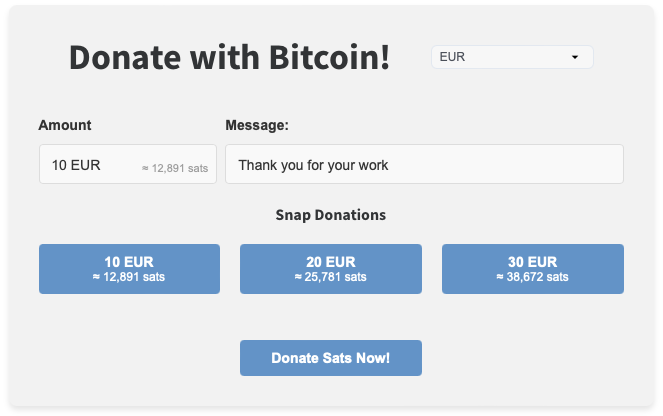
“Multi-Amount” (three preset donation amounts)

Predefine three fixed contribution amounts with the Multi-Amount Donation FormThis is a donation form that three predefined amounts to choose from. For example, you could offer €5, €10, €20 in sats to choose from (you define the exact values in the plugin setting). The user then simply clicks on one of the buttons instead of entering an amount themselves. Of course, a message field can also be included here. Multi-Amount is suitable for giving donors an orientation many then opt for the average value. It lowers the cognitive hurdle (“How much should I give?”). Technically, the plugin generates three buttons next to each other. As soon as the user clicks on one, the payment process runs in exactly the same way as with the simple model. This format is ideal for donation pageswhere you ask for support and provide suggestions straight away.
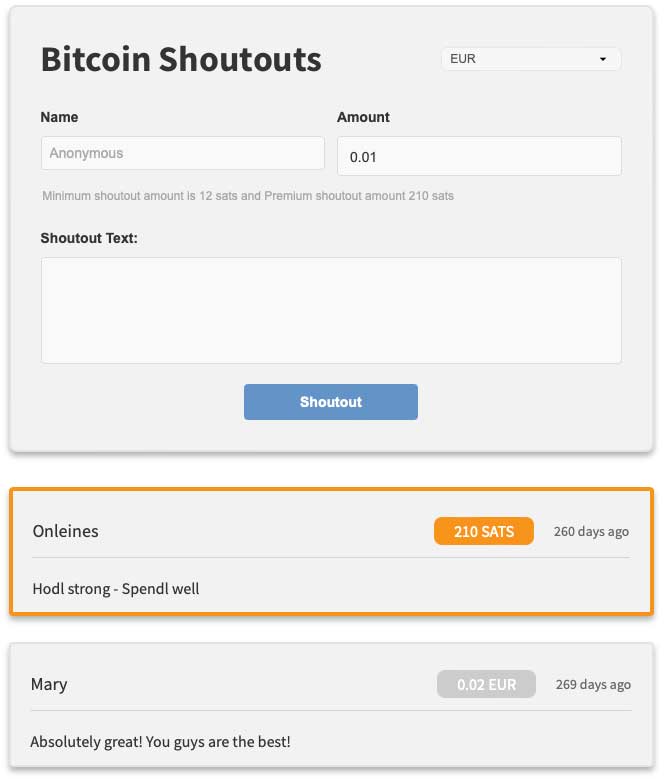
Test Coinsnap Bitcoin Donation

Try live demo


“Shoutout”

Let contributors leave a public message with the Bitcoin Shoutouts plugin

This is the special model where the donor receives a public message/comment can leave. The form asks for a nickname and the message (amount too, of course), and after payment this message is displayed on your website – either directly next to the donation form or collected on a special page: you can place the shoutout list via shortcode wherever you want.

This model is great for engaging the community: Donors feel heard because their message is visible. Example: A reader donates 500 sats and writes “Great article, helped me a lot! – Max”. This message may then appear below the article in a list of supporter comments. In this way, new visitors will also see that your work is appreciated and may be motivated to donate and write something as well.

Spam protection is automatically provided – anyone who wants to troll would have to pay at least a few satoshi, which significantly increases the inhibition threshold. Many creators use shoutouts to enable live interactions (e.g. you could read out the latest shoutouts in the stream, etc.). The Coinsnap plugin offers this function out-of-the-box, which sets it apart from other donation solutions.

With its features and user-friendliness, the Coinsnap Bitcoin Donation Plugin is an all-round well thought-out solution for WordPress: It combines user-friendliness user-friendliness, flexibility and security. Whether you simply want to add a small donation button or an interactive donation board with comments – the plugin provides the necessary functions.

In addition, it is free of charge and advertises with strong arguments such as instant credit to your wallet, absolutely beginner-friendly and GDPR-compliant. For bloggers and influencers who want to set foot in the Bitcoin world, trying out this absolutely recommend trying out this plugin!

Test Coinsnap Bitcoin Shoutout

Try live demo

Conclusion: Bitcoin Donations for WordPress open up new sources of income

Bitcoin Donations for WordPress are more than just hype – they offer WordPress bloggers and content creators a new, future-oriented source of income.

Low fees, global reach and technical simplicity make Bitcoin donations an attractive alternative or supplement to traditional donations via PayPal & Co. WordPress users benefit in particular from special plugins such as Coinsnap, which make integration a breeze. We have seen that anyone can set up a Bitcoin donation function on their site in just a few steps – and thus provide their community with a modern way to donate, say thank you in the form of Bitcoin in the form of Bitcoin.

For you as a blogger/influencer, this means: why not simply test? Set up Bitcoin donations on your website today – for example with the Coinsnap plugin presented here – and convince yourself of the possibilities . Your readers will love having another option to support you. And you’ll open up a source of income that fits perfectly into the digital age.

Get Bitcoin Donations for WordPress now

Download plugin on WordPress

Coinsnap Bitcoin Voting: Create secure, interactive and profitable polls and earn Bitcoin with every vote!

In a digital world full of bots, spam and fake surveys, it is becoming increasingly important to distinguish genuine user interaction from automated distortion. This is exactly where our new, innovative solution comes in: Bitcoin Voting with the Coinsnap plugin for WordPress.

With the Coinsnap Bitcoin Voting plugin, you can not only offer secure, paid voting on your WordPress website, but also earn a few Satoshis – the smallest unit of Bitcoin – along the way.

Find out more in this article:

  • What Bitcoin Voting is
  • What advantages it offers – for you and your visitors
  • How to install and configure the Coinsnap plugin
  • For whom Bitcoin Voting is particularly worthwhile
  • How you can even use the voting plugin as a competition

What is Bitcoin Voting?

Bitcoin Voting is an innovative voting system in which participants make a small Bitcoin payment to take part in a survey or vote.

With the Coinsnap Bitcoin Voting plugin for WordPress, this payment is processed in sats (satoshis) – micropayments that are perfect for interactions on the web.

The idea behind it: Anyone who wants to vote must pay a small amount – e.g. 50 or 100 sats. This makes participation valuable, spam-resistant and bot-proof. At the same time, the site operator receives a small reward – in the form of Bitcoin.

Why paid votes?

In traditional online surveys, it is almost impossible to prevent bots, multiple participation or manipulation.

Coinsnap Bitcoin Voting solves this problem with a simple but effective mechanism: only those who pay are allowed to vote. And of course you can also specify that each visitor can only vote once!

Advantages of Bitcoin Voting:

  • Protection against bots and spam votes
  • Higher quality interactions through real users
  • Small additional income through micropayments
  • Low entry barrier for participants (a few sats)
  • Full control over options, duration and conditions

Be creative and decide:

  • How many possible answers there are (up to four)
  • What choices your voters have
  • How many sats a vote costs
  • Whether multiple votes are allowed
  • How long the voting runs for
  • Whether additional information (name, e-mail, address) is requested – e.g. for competitions

How easy the Coinsnap Bitcoin Voting plugin works


The Coinsnap Bitcoin Voting plugin is specially developed for WordPress and is very easy to set up. It works with the Coinsnap Gateway (for which you don’t need any specialist knowledge) as well as with your BTCPay Server if you are an advanced Bitcoiner.

And, most importantly, with Coinsnap Bitcoin Voting you are completely independent of third-party providers or central payment services – so you don’t have to answer endless questions or provide extensive proof or documents: To bring Bitcoin Voting to your WordPress site with Coinsnap, all you have to do is register with your email address, your website URL and the address of your Bitcoin Lightning wallet.

Ready to go in just three steps

If you want, you can offer Bitcoin Voting on your website in just 10 minutes. It’s very simple:

Install the plugin

Download the Coinsnap Bitcoin Voting plugin from the WordPress plugin directory or from Github.

Configure a poll

Specify the voting options, define the price per vote and select the desired additional functions (e.g. conditions of participation, duration of poll, requesting information).

Place the poll

Insert the generated shortcode at the desired position on your website – done!

What are the technical requirements?

The technical requirements for using Coinsnap Bitcoin Voting are minimal. All you need is:

  • an up-to-date WordPress website
  • the Coinsnap Bitcoin Voting plugin
  • Coinsnap account (and if necessary your own BTCPay server)
  • Bitcoin Lightning wallet for receiving the sats

Example: A Bitcoin vote on your website could look like this

Imagine you run a Bitcoin blog and want your readers to vote on which Bitcoin Lightning wallet is the best. In the config-tab you create a poll with four options:

  • Wallet of Satoshi
  • Blink Wallet
  • Strike Wallet
  • Aby Wallet

You specify that each vote costs 21 sats (less than a cent at the current exchange rate). Your readers choose their favourite wallet, pay the amount via Lightning – and you not only get a real result, but also a small reward!

Bitcoin voting as part of a competition

A particularly exciting feature of the Coinsnap plugin is the option to expand the voting into a competition. You can specify that participants also leave personal details such as their name, email or address so that you can send them the prize if they win.

This makes Bitcoin Voting not only a tool for voting, but also a smart tool for:

  • Customer loyalty
  • Newsletter development
  • Lead generation
  • Community campaigns

In short: Coinsnap Bitcoin Voting is more than just a voting tool. With this plugin you can activate your followers, generate new income and gain interesting insights into the opinions and interests of your crowd!


Results of a Coinsnap Bitcoin Voting poll

For which WordPress bloggers or website operators is Bitcoin Voting worthwhile?

Bitcoin Voting is suitable for all WordPress operators who want to encourage genuine user participation and at the same time benefit from a small but steady stream of income.

The plugin is particularly worthwhile for:

Content creators and bloggers
Offer your community the opportunity to co-create content – in return for a small Bitcoin donation.

Shop operators
Let customers vote on new products or designs – and combine the voting with exclusive discounts or giveaways.

Clubs and communities
Organise democratic, tamper-proof votes within your community.

Startups and developers
Test feature ideas with real users – and use the payment principle to filter out only serious opinions.

Conclusion: Bitcoin Voting – the perfect combination of user participation and monetisation

Get more out of your website with the Coinsnap Bitcoin Voting plugin. You activate your visitors, offer them an interesting form of co-determination and protect your surveys from manipulation at the same time. And best of all: you earn a few sats with every vote.

The plugin can be seamlessly integrated into WordPress, is flexibly customisable and even offers the option of running competitions. For anyone who uses Bitcoin – or wants to try it out – this tool is an easy way to combine web interaction and Bitcoin microtransactions.

Coinsnap Bitcoin Paywall

Accept Bitcoin Lightning payments for your content

The Coinsnap Bitcoin Paywall protects your high-quality content and ensures that you are fairly remunerated for your work.

It allows you to build a sustainable source of income and be less dependent on advertising revenue or sponsors. With your Coinsnap Bitcoin paywall, you can target loyal users who are willing to pay, which leads to a high-quality community in the long term.

The Coinsnap Bitcoin Paywall allows you to accept Bitcoin for exclusive content and clearly differentiate your offer from the competition. This is how you create added value – both for yourself and for the growing target group of Bitcoin customers!

Works with the Coinsnap gateway or your BTCPay server!


Coinsnap Bitcoin Paywall Demos

If you want to try out for yourself how you can accept Bitcoin Lightning payments for your content with the Coinnap Bitcoin Paywall, check out our demos:

On our demo store page you will find a text or video that you can download for 1o cents (111 SATS). Select it to test payment with Bitcoin and Lightning right away!

“Pay now” if you want to load the content!

Simply click on the “Pay now” button to start the payment test.


Now hold the camera of your Bitcoin Lightning Wallet on the QR code and click on “pay” or “send”, depending on what your wallet offers you.

At the end you will receive a QR code that you should scan with your wallet to pay with Coinsnap Bitcoin and Lighhtning!

You will then see a short confirmation of your payment and will be redirected back to the now released content!

Installation of the Coinsnap Bitcoin Paywall

Coinsnap Bitcoin Paywall in WordPress

To use the Coinsnap Bitcoin Paywall, the plugin must of course be installed on your WordPress website.

If you have not yet installed the Coinsnap Bitcoin Paywall, it is best to install it directly from the plugin offer in your WordPress.

Of course, you can also download the plugin from Github and install it manually (more on this below).

How to install your Coinsnap Bitcoin Paywall plugin directly in WordPress:

Go to the plugin area and click on “add new plugin”. Then enter “Coinsnap Paywall” in the search field and you will see our plugin in the selection.

Now click on “Install now”, and when the installation is complete, click on “activate”.

And your Coinsnap Paywall plugin is already installed and activated!

Now all you have to do is configure the plugin settings and you can make content available for Bitcoin on your website!

You can see how to configure the plugin here.

Download Coinsnap Bitcoin Paywall on Github

If you want to install the Coinsnap Bitcoin Paywall, you must first download it from the Coinsnap Github page here.

Then look for the green button labeled “Code”. When you click on it, the menu opens and Download ZIP appears.

Here you can download the latest version of the Coinsnap Bitcoin Paywall to your computer.

Download Coinsnap Bitcoin Paywall now


Connect Coinsnap account with Bitcoin Paywall

As soon as you are registered with Coinsnap, log in to your modified store and go to the backend.

Coinsnap Bitcoin paywall settings

After you have installed and activated the Coinsnap Bitcoin Paywall, you must make the Coinsnap settings. You can find these in the sidebar on the left under “Coinsnap Bitcoin Paywall”.


Simply enter your Coinsnap Store ID and your API key there; you can find these in your Coinsnap account under “Settings”, “Coinsnap Shop Settings”.


Connect your BTCPay Server with the Coinsnap Bitcoin Paywall plugin

Bitcoin Paywall BTCPay Server Settings

After you have installed and activated the Coinsnap Bitcoin Donation plugin, you need to configure the Coinsnap settings. Go to BTC Paywall -> Settings [1] in the black sidebar on the left.

Now choose your payment gateway BTCPay [1] and click save.

Now, log into your BTCPay Server. If you’ve done that, enter your BTCPay Server URL into the matching field in the Donation Settings tab [1].

Next, you’ll have to click on the Generate API Key button [2].

You’ll then be forwarded to your BTCPay Server.

Choose your Shop [1], then click on continue [2].

You’ll then be forwarded to this screen. Enter your store’s name on the top [1], and then click on authorize app [2].

Your BTCPay Server is now successfully connected to your blog or website, via the Coinsnap Bitcoin Paywall plugin!

(If you click on check you will get the success notice (in green)).

You have now successfully activated your Coinsnap Bitcoin Paywall and can now accept Bitcoin Lightning for your content.

Configure Coinsnap Bitcoin Paywall

1. create a paywall shortcode

Go to Coinsnap Bitcoin Paywall in the sideboard on the left in your WordPress and click on Paywall Shortcodes.

Then click on “Add New Paywall Shortcode” at the top.

2. configure your paywall shortcode

In the window that now appears, make the following settings (see orange entries):

  1. First you assign a name so that you know later what the short code is intended for.
  2. Then you can enter a short description as background information for yourself or your editors.
  3. Then set the text of the payment button.
  4. Set your price!
  5. Select the currency in which the price is to be displayed
  6. Set the duration of the activation and
  7. select the color scheme of the paywall.

Now you can copy the shortcode at the bottom and use it in your content (see below).

Put content behind the Coinsnap Bitcoin paywall

1. create content

Now create content as usual in your WordPress, for example a text as in this example.

As soon as you have finished the article, you must place the shortcode you have just produced at the point where you expect payment from your reader. You usually do this after the introductory paragraph, see right:

Tip:

If you want to place a paywall before the download of a video, create a short description of the video content as an introduction and place an image of the start screen of the video next to it.

This way, your users can see what they can expect and why they want to pay for the video!

Coinsnap now also for Contact Form 7

Coinsnap now also for Contact Form 7

Coinsnap: Bitcoin Lightning payment available for Contact Form 7!

Frankfurt/Main, August 4, 2024 – Contact Form 7, the most popular form generator in the WordPress world with over 10 million downloads, can now also be used for simple payment transactions in Bitcoin Lightning with Coinsnap.

The Bitcoin Lightning payment provider Coinsnap has released a free plugin that allows WordPress website operators to offer Bitcoin Lightning payments in their Contact Form 7 forms in just a few minutes. All they have to do is create an account with Coinsnap, enter their Lightning Wallet address and install the plugin. Apart from their email and Lightning Wallet address, no further details are required to receive Lightning credits in their own Lightning Wallet immediately.

Jens Leinert, Head of Business Development at Coinsnap, is convinced that WordPress website and blog operators can use Coinsnap for Content Form 7 to generate additional revenue in the growing Bitcoin-affine target groups: “With our plugin, influencers, blog operators and online experts of all kinds can, for example, accept donations for their videos or podcasts, offer fan merchandise such as coffee mugs or T-shirts for sale or offer personal online meetings for a participation fee.” And all this without having to integrate more complex technologies such as Woocommerce into their WordPress websites or apply for acceptance contracts with credit card or payment service providers such as Stripe or Paypal.

According to Leinert, there is currently no payment method that allows WordPress users to offer simple payment processes with Bitcoin Lightning in a simpler, less complicated and faster way than Coinsnap. “All our customers need is an email address to set up their Coinsnap account and install a Bitcoin lending wallet on their smartphone,” emphasizes Leinert. After that, all they have to do is download and install the Coinsnap for Contact Form 7 and enter some data from their account and wallet. “From then on, all proceeds are credited to your Bitcoin Lightning wallet in real time, guaranteed and irrevocable,” explains Leinert. Creating a form in Contact Form 7 to collect donations or sell a fan article, for example, is extremely simple and is explained directly in Contact Form 7 once the plugin has been installed. Sample code is also available there, which the Contact Form 7 user only has to copy into a new form and then adapt to their needs.

“Turning a form into a mini-shop is really child’s play and can be done in just a few minutes,” promises Leinert. The Coinsnap for Contact Form 7 can currently be downloaded from Github, a listing in the WordPress plugin directory will follow shortly. Coinsnap also supports WordPress operators with a demo page on which interested parties can carefully test Bitcoin Lightning Payment with Contact Form 7. There is also a detailed step-by-step guide for implementation.

Further information:

Demo store Coinsnap for Contact Form 7: https://contactform7.coinsnap.org

Installation instructions for Coinsnap for Contact Form 7: https://coinsnap.io/en/coinsnap-for-contact-form-7/

Github-Page for Coinsnap for Contact Form 7: https://github.com/Coinsnap/Coinsnap-for-Contactform7