
A Simple Guide for Merchants to Accept Instant Bitcoin Payments
What Is the Bitcoin Lightning Network?
 Lightning is a payment network built on Bitcoin that makes Bitcoin payments as fast and easy as sending a message.
For merchants, this means customers can pay instantly with Bitcoin — online, in-store, or via invoice — without waiting several minutes for a transaction to confirm.
Lightning payments are fast, inexpensive, global, and final. There are no chargebacks, no banks involved in the payment itself, and merchants can receive payments directly into their own Bitcoin wallet.
In this guide, we explain in simple terms what the Lightning Network is, how it works, why businesses are increasingly using it, and how you can start accepting Lightning payments yourself.
WHAT IS THE LIGHTNING NETWORK?
What Is the Lightning Network?
The Lightning Network is a payment system built on top of Bitcoin that enables fast, low-cost Bitcoin payments. It allows customers to pay merchants instantly using Bitcoin through QR codes and Lightning wallets, making Bitcoin practical for everyday business transactions.
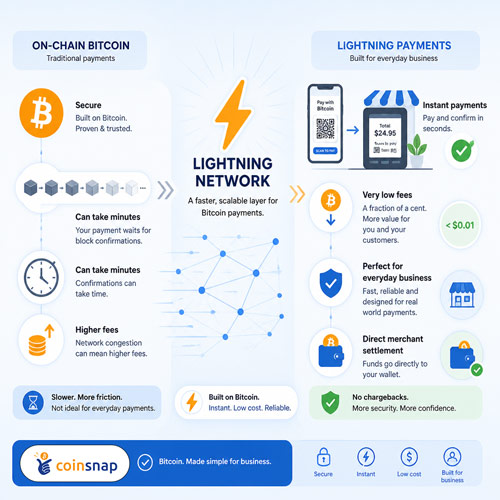 The Lightning Network is a payment system built on top of Bitcoin.
Its purpose is simple: Make Bitcoin payments fast enough and cheap enough for everyday use.
While normal Bitcoin transactions are highly secure, they are not always ideal for small, instant payments. Depending on network activity, a regular Bitcoin transaction can sometimes take several minutes to confirm and may involve higher transaction fees.
The Lightning Network solves this problem by enabling near-instant Bitcoin payments with extremely low fees.
For merchants, using Lightning feels much closer to accepting a card payment or a digital wallet payment — but without banks, card networks, or chargebacks.
WHY NORMAL BITCOIN TRANSACTIONS CAN BE SLOW
The Bitcoin network processes transactions in blocks. New blocks are added approximately every 10 minutes. During busy periods, transactions may take longer to confirm if users compete for space in those blocks.
This works well for large payments, savings transfers and high-security transactions.
But it is less practical for normal online shops and online checkouts, subscriptions, fast invoice payments, cafés, restaurants, retail stores, tips et cetera.
Customers and merchants generally expect payments to complete immediately. This is exactly what the Lightning Network was designed for.
WHAT LIGHTNING CHANGES
The Lightning Network changes Bitcoin from a system mainly used for larger or slower transactions into a payment method that works for everyday business.
With traditional Bitcoin payments, every transaction must first be confirmed by the Bitcoin blockchain. Depending on network activity, this can sometimes take several minutes and may involve higher transaction fees.
The Lightning Network was designed to solve exactly this problem.
Instead of waiting for every small payment to be individually confirmed on the blockchain, Lightning enables payments to move instantly between users through a much faster payment layer built on top of Bitcoin.
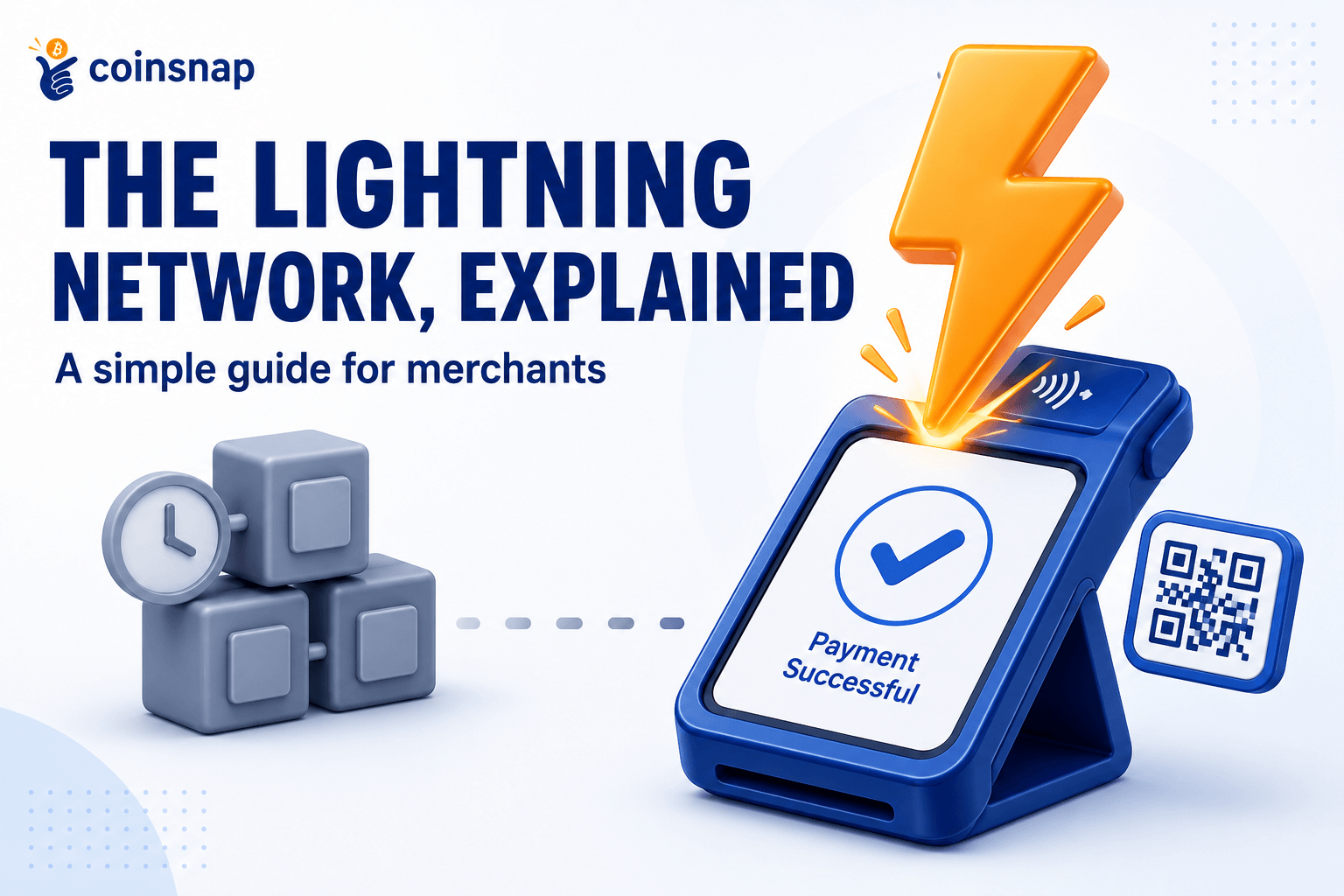
For merchants and customers, the experience is simple and familiar. At checkout, the customer scans a QR code with their Lightning wallet, confirms the payment, and within seconds the payment arrives in the merchant’s wallet. There is no waiting for bank approvals, no card authorization process, and no delayed settlement.
At the same time, Lightning payments are extremely inexpensive. Typical transaction costs are often only a fraction of a cent, making even very small payments economically practical.
This combination of speed, low fees, and instant settlement makes Lightning especially attractive for everyday commercial use cases such as:
- online shops
- digital products and downloads
- subscriptions and memberships
- restaurants and cafés
- food delivery services
- in-store point of sale payments
- invoice payments
- donations and crowdfunding
- international business payments
For many businesses, Lightning feels much closer to a modern digital payment system like card payments or mobile wallets — but without banks, card networks, or chargeback risk.
WHAT A LIGHTNING PAYMENT LOOKS LIKE
From the customer perspective, a Lightning payment is extremely simple.
Online Store Example:
- The customer selects Bitcoin & Lightning at checkout
- A QR code appears
- The customer scans the QR code with their Lightning wallet
- The payment is confirmed instantly
- The order is completed
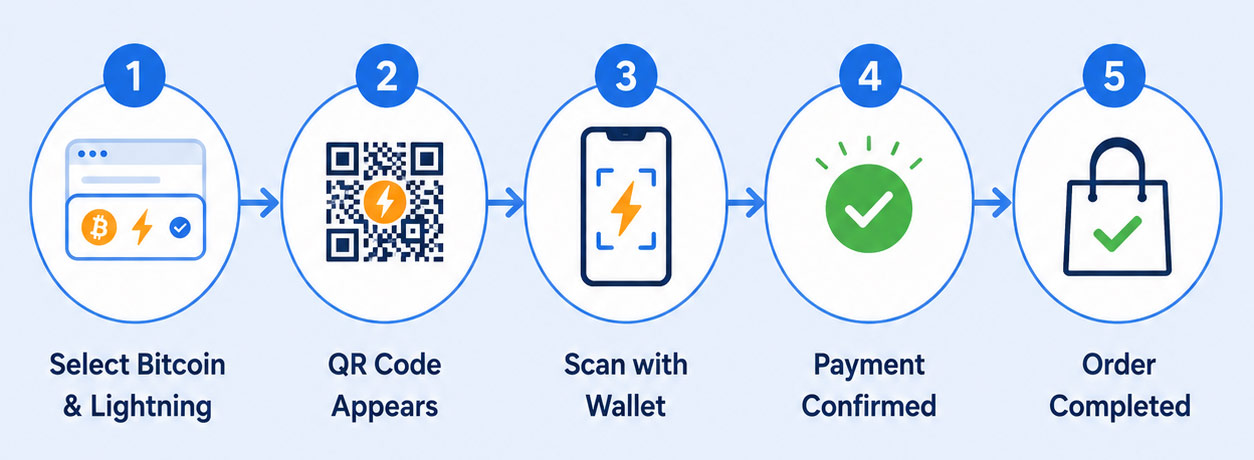
The entire process often takes less than five seconds.
LIGHTNING VS NORMAL BITCOIN TRANSACTIONS
| Feature | Bitcoin (On-Chain) | Lightning |
|---|---|---|
| Speed | Minutes | Seconds |
| Fees | Can vary | Very low |
| Best for | Large payments | Everyday payments |
| Checkout Experience | Slower | Instant |
| Ideal Use Cases | Savings, large transfers | Ecommerce, PoS, Retail, Invoices |
Both systems use Bitcoin. Lightning simply makes Bitcoin practical for everyday (e)commerce.
LIGHTNING VS CREDIT CARDS
For merchants, Lightning payments differ from card payments in several important ways.
| Feature | Credit Cards | Lightning |
|---|---|---|
| Chargebacks | Possible | Not possible |
| Settlement Time | Often days | Instant |
| Transaction Fees | Usually higher | Usually very low |
| International Payments | Complex | Native/global |
| Bank Dependency | Required | Not required |
One of the biggest differences is final settlement. Once a Lightning payment is completed, it cannot be reversed by the customer through a chargeback process. This reduces fraud risk for merchants.
LIGHTNING VS PAYPAL
PayPal and Lightning both allow digital payments, but they work very differently. PayPal is a centralized financial platform. Lightning is an open Bitcoin payment network.
With Lightning:
- merchants can receive payments directly into their own wallet
- payments work globally
- users do not need a bank account
- there are no card networks involved
- merchants keep more control over their funds
For international business, Lightning can also significantly simplify cross-border payments.
WHAT IS A LIGHTNING WALLET?
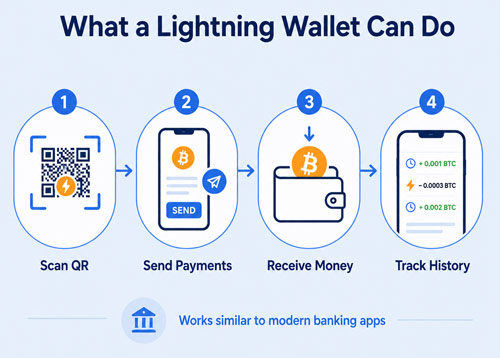 A Lightning wallet is an app or service that allows users to send and receive Lightning payments. Customers use Lightning wallets to pay. Merchants use Lightning wallets to receive payments.
Many Lightning wallets work similarly to modern banking apps:
- scan QR codes
- send payments
- receive payments
- track transaction history
Some wallets are custodial, meaning a provider holds the Bitcoin for the user. Others are non-custodial, meaning the user fully controls their own funds.
Popular Lightning wallets include:
- Coinsnap
- Wallet of Satoshi
- Misty Breez
- Strike Business
- Strike
- Alby
- Phoenix
- Blue
- Breez
- Zeus
WHAT IS A LIGHTNING ADDRESS?
A Lightning address is a simple payment identifier for Bitcoin Lightning payments. It works similarly to an email address and usually looks like this: name@wallet.com
Instead of sharing long Bitcoin wallet strings or generating a new QR code for every transaction, users can simply share their Lightning address to receive payments.
For customers, sending Bitcoin to a Lightning address feels very similar to sending an email or making a payment through a modern banking app.
In most cases, when you install and set up a Lightning wallet, you automatically receive a Lightning address as part of the wallet setup process. Many wallet providers even allow users to personalize or customize their Lightning address ( e.g. yourname@wallet.com), making it easier for customers to recognize and remember.
When a customer authorizes a Lightning payment to you, the Lightning Network automatically routes the payment into your Lightning wallet. This happens in seconds and without the delays typically associated with traditional banking systems or card networks.
HOW BUSINESSES CAN ACCEPT LIGHTNING PAYMENTS
Merchants can accept Lightning payments in many different ways, depending on their business model and how they interact with customers.
For online stores, Lightning can be integrated directly into the checkout process, allowing customers to pay with Bitcoin just like they would with a credit card or digital wallet. After selecting Bitcoin & Lightning at checkout, the customer scans a QR code and the payment is confirmed almost instantly.
In physical stores, cafés, restaurants, or market stands, merchants can use a Lightning-enabled point-of-sale system on a smartphone, tablet, or computer. The cashier enters the amount, a QR code appears, and the customer pays directly from their Lightning wallet within seconds.
Lightning payments can also be accepted through payment links. In this setup, the merchant creates a payment link and sends it to the customer by email, messenger, or invoice. When the customer opens the link, a payment page appears where the Bitcoin payment can be completed immediately.
For invoice payments, businesses can include a Lightning payment option directly on their invoices. This is especially useful for freelancers, agencies, consultants, wholesalers, or B2B businesses that want to receive international payments quickly and with minimal transaction costs.
Many organizations and content creators also use Lightning on donation pages, allowing supporters to contribute instantly with very small transaction fees. Because Lightning supports even tiny payments economically, it is particularly well suited for donations, tips, and crowdfunding.
Subscription businesses and membership platforms can also use Lightning payments for recurring billing models, digital memberships, premium content access, or software subscriptions.
LIGHTNING PAYMENT SETTLEMENT OPTIONS FOR MERCHANTS
Depending on the chosen setup, merchants have different options for how they receive and manage their payments.
Some merchants prefer to receive Bitcoin directly into their own Lightning wallet, giving them full control over their funds without intermediaries.
Others prefer automatic conversion into euros or other fiat currencies. In this case, the customer still pays with Bitcoin, but the merchant receives the equivalent fiat amount in their bank account, reducing exposure to Bitcoin price fluctuations.
More technically advanced merchants may connect their own BTCPay Server to manage payments independently with maximum control and self-custody.
Businesses looking for a simpler setup often use a payment provider such as Coinsnap, which handles the payment processing and integration while still allowing merchants to receive payments directly into their own wallet or through optional fiat settlement partners.
WHY BUSINESSES ARE STARTING TO ACCEPT LIGHTNING
Businesses adopt Lightning for a variety of practical and strategic reasons. For many merchants, the main advantages are lower transaction fees, instant settlement, fewer chargebacks, and the ability to accept payments from customers worldwide without relying entirely on traditional banking infrastructure.
Other businesses see Lightning as a way to modernize their payment setup, offer customers more payment flexibility, and reduce dependency on conventional payment providers and card networks. At the same time, accepting Bitcoin payments can help attract a growing audience of Bitcoin users who actively prefer to spend digitally and internationally.
Lightning is particularly attractive for industries where fast, low-cost, and borderless payments matter most. This includes ecommerce, hospitality, restaurants and cafés, retail, digital services, SaaS businesses, freelancers, as well as donation and crowdfunding platforms.
HOW COINSNAP WORKS WITH LIGHTNING
Getting started with Lightning payments no longer requires running complex infrastructure, managing nodes, or rebuilding your entire checkout process. With Coinsnap, merchants can start accepting Bitcoin and Lightning payments online and at the point of sale in just a few minutes — with payments sent directly into their own wallet.
Whether you run a WooCommerce shop, a Shopify store, a Magento or Prestashop installation, a Drupal website, a Shopware setup, or a WordPress-based business, Coinsnap integrates seamlessly into your existing workflow without disrupting your operations or customer experience.
And it goes far beyond traditional online stores: You can accept Lightning payments through payment links, browser-based Bitcoin point-of-sale systems, invoices, donation forms, membership sites, crowdfunding pages, and many other business scenarios where fast, global payments matter.
The setup is intentionally simple
Create your Coinsnap account, connect your Lightning wallet, install the plugin or activate one of the payment tools — and you are ready to receive Bitcoin payments almost instantly.
Behind the scenes, Coinsnap combines the speed of Lightning with the reliability merchants need for real business operations. Merchants can accept both Lightning and on-chain Bitcoin payments, receive funds directly into their own wallet, optionally settle into fiat currency through integrated partners, and benefit from instant payment confirmation for both ecommerce and in-person transactions.
For many businesses, Lightning changes the entire payment experience
No waiting days for settlements. No chargeback risk. No unnecessary intermediaries. Just fast, modern, global payments that work.
If you want to explore what accepting Lightning payments could look like in your own business, Coinsnap offers one of the fastest and easiest ways to get started.
Built for real merchant needs
Most Coinsnap modules also include features designed specifically for real-world merchant needs. Businesses can offer automatic Bitcoin discounts at checkout, connect their own BTCPay Server for maximum independence, and freely choose how they want to receive payouts — directly into a Lightning wallet, an on-chain Bitcoin wallet, a fiat bank account through settlement partners, or hybrid combinations of these options. The entire system is designed as a non-custodial solution, meaning merchants retain control over their funds at all times.
And for businesses that prefer a hands-off onboarding process, Coinsnap also offers a free integration and installation service for many platforms and shop systems.
LIGHTNING — A WIN-WIN PAYMENT SOLUTION FOR YOUR BUSINESS
The Lightning Network makes Bitcoin practical for everyday payments. It allows businesses to accept instant Bitcoin payments with low fees, immediate settlement, and no chargebacks — online and in physical stores.
For merchants, Lightning is not about speculation or complex crypto technology. It is simply a modern payment system built for fast digital commerce.
And with solutions like ours, you can start accepting Lightning payments without needing deep technical knowledge or complex infrastructure. And there is not even any real financial risk involved: setup takes only a few minutes, the software and integrations are free, and the fees are minimal — and only charged when you actually make sales and receive payments.
FAQ
Lightning payments use Bitcoin’s underlying security model while enabling faster transactions.
For merchants, Lightning is generally considered secure for everyday commerce.
As with any payment system, good wallet security and proper operational practices are important.
Customers need a Lightning-compatible Bitcoin wallet with Bitcoin funds available.
Most Lightning wallets are free to install and easy to use.
Some Lightning service providers and partners allow automatic conversion from Bitcoin into euros or other fiat currencies.
This means customers can pay with Bitcoin while merchants receive fiat currency in their bank account.
Many merchants use hosted solutions or payment providers like Coinsnap that simplify the entire setup process.
More advanced users can also connect their own BTCPay Server or self-hosted infrastructure if they prefer full control.