
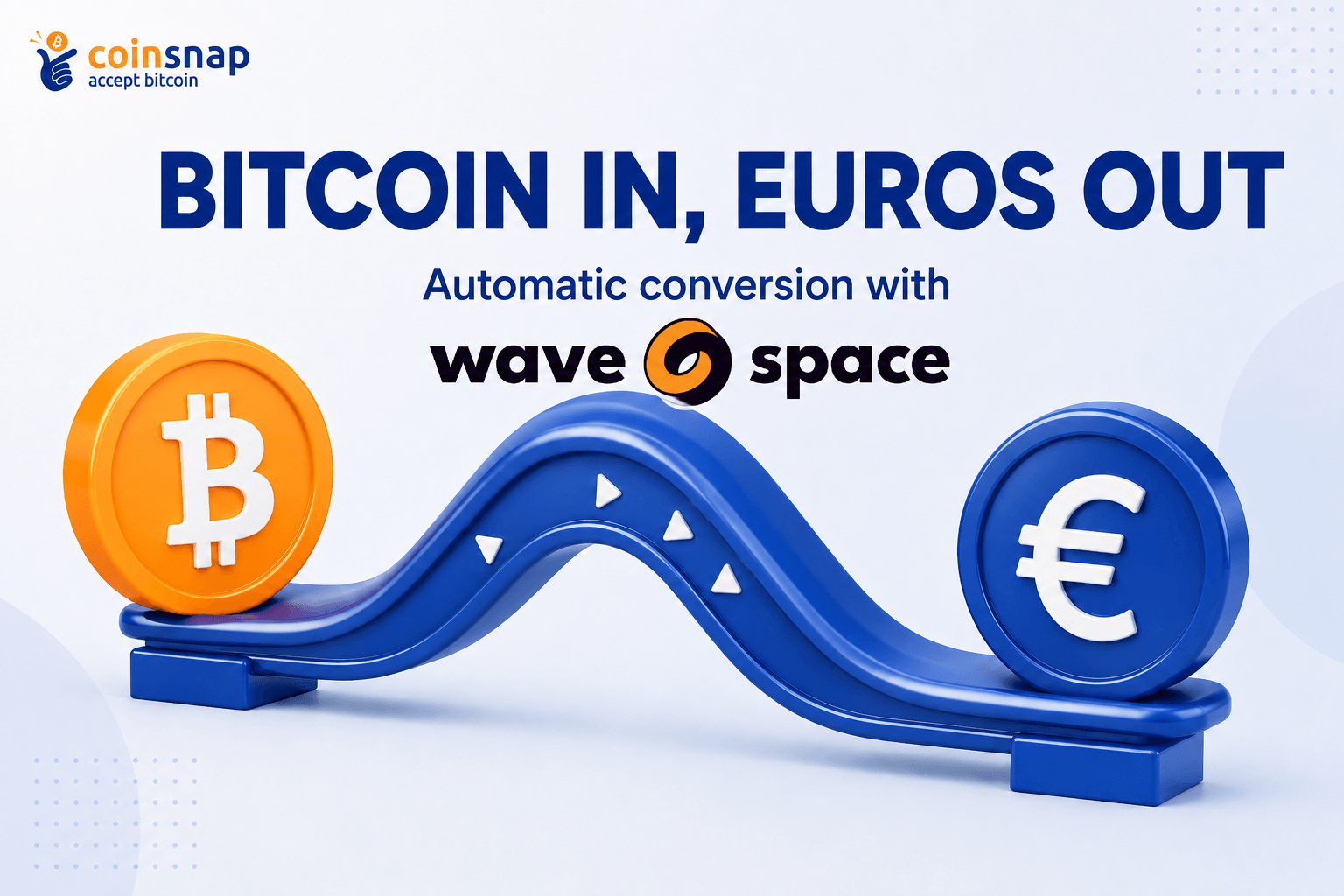
Wave.space & Coinsnap: A Smooth Way to Accept Bitcoin and Receive Euros
Wave.space may be the right solution for many merchants who find Bitcoin payments interesting, but do not necessarily want to hold Bitcoin. A shop owner may want to accept Bitcoin because customers ask for it. A service provider may value the speed of Lightning payments. A business may want to avoid chargebacks or receive international payments more easily.
But at the end of the day, many businesses still pay their rent, suppliers, staff, and taxes in euros. That creates a simple question. Can a customer pay in Bitcoin, while the merchant receives euros?
Coinsnap already offers solutions for this. With partners such as Bringin and DFX, merchants can accept Bitcoin payments through Coinsnap and receive the value in euros instead of keeping Bitcoin on their balance sheet. These options are especially useful for businesses that want to offer Bitcoin at checkout, but still manage their daily operations, accounting, and cash flow in fiat currency.
And now, with Wave.space, Coinsnap merchants have an even simpler, more elegant, and more convenient way to sell for Bitcoin — while receiving euros: With the new Wave.space app, and its new Lightning address feature, Wave.space now makes this process even easier. With just one small addition to that address, incoming Bitcoin payments can be converted into euros automatically.
Can I auto-convert Bitcoin to Euro with Coinsnap?
Yes. With Coinsnap and a wave.space Lightning address like yourname.eur@pay.wave.space, incoming Bitcoin payments can be automatically converted into euros and credited to your personal vIBAN.
A Lightning Wallet for Bitcoin — With a Built-In Euro Option
Wave.space works like a classic Lightning wallet. You can use it to send Bitcoin, receive Bitcoin, and handle everyday Lightning payments in the usual way. But Wave.space adds one feature that makes it especially interesting for merchants: every wallet comes with a personal Lightning address. A normal Wave.space Lightning address looks like this: myname@pay.wave.space
This address works like a reusable Bitcoin payment address. People can send Bitcoin to it, and the payment arrives in your Lightning wallet. The clever part starts when you add “.eur” to the name part of the address. So instead of: myname@pay.wave.space you use: myname.eur@pay.wave.space
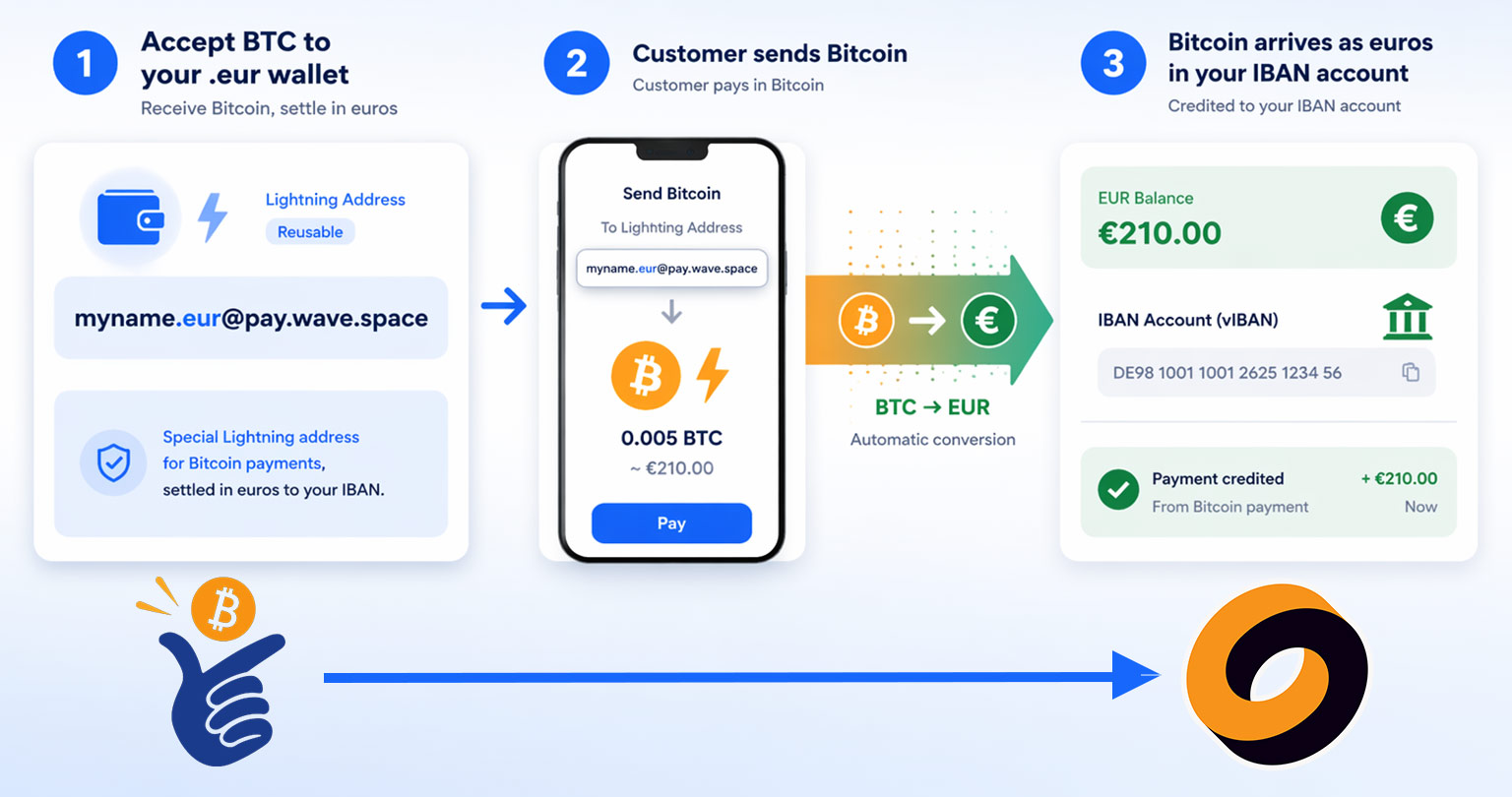
For the customer, nothing changes. They still pay with Bitcoin. But now the payment flow changes. The sender still pays in Bitcoin, but Wave.space automatically converts the incoming BTC into euros and credits the amount to the user’s personal vIBAN.
For merchants, this is the important point. The same Wave.space wallet can be used as a normal Lightning wallet when you want to receive Bitcoin, or as a simple BTC-to-euro receiving solution when you prefer to settle incoming Bitcoin payments in euros.
That makes it a very practical option for Coinsnap merchants who want to accept Bitcoin payments, but keep their business cash flow in euros.
Why This Matters in Normal Business Life
Many businesses are not trying to become Bitcoin treasury companies. They simply want another payment option. They want customers to be able to pay with Bitcoin, but they also want their accounting to remain simple. They want to know how much money they have in euros. They want to pay invoices from suppliers. They want to avoid extra manual work.
This is where the Wave.space Lightning address can help. The merchant can decide from the beginning what should happen with incoming payments. If they want to keep Bitcoin, they use the normal address. If they want euros, they use the “.eur” address.
That makes the setup easy to explain, easy to remember, and easy to operate.
A Simple Example
Imagine a small online shop that uses Coinsnap to accept Bitcoin payments. The shop owner likes the idea of Bitcoin payments, but does not want to hold Bitcoin every day. The business buys goods in euros, pays rent in euros, and does bookkeeping in euros. So instead of connecting a Bitcoin-only Lightning wallet in his Coinsnap account, the shop owner connects a Wave.space address like:
Now customers can still pay with Bitcoin at checkout. But when the payment reaches the Wave.space address, it is converted into euros automatically. The shop owner does not need to explain Bitcoin to the accountant. The business does not need to manually convert every payment. And the customer still gets the Bitcoin payment option they wanted.
The Normal Bitcoin Address Still Has Its Place
Of course, not every merchant wants automatic conversion. Some merchants want to receive and keep Bitcoin. For them, the normal Wave.space Lightning address is the better option. That would look like this:
In that case, Bitcoin payments remain Bitcoin payments. This gives merchants a clear choice. They can use the normal address when they want Bitcoin, or the “.eur” address when they prefer euros. That is the strength of the setup. It does not force one model on every business.
The “Link” Feature Works in the Other Direction
Wave.space also introduced another feature called Link. This feature should not be confused with the “.eur” Lightning address.
The “.eur” Lightning address is about receiving Bitcoin and converting it into euros. The Link feature works in the other direction. It gives a wallet its own dedicated IBAN. When euros are sent to that IBAN, Wave.space automatically converts the euros into Bitcoin and sends the Bitcoin to the selected wallet.
So Link is mainly useful when someone wants to move euros into Bitcoin automatically. For Coinsnap merchants, the more relevant feature is usually the Lightning address with “.eur”, because it can help turn incoming Bitcoin payments into euros.
A More Practical Way to Use Lightning
The new Wave.space app is interesting because it makes Bitcoin payments easier to handle in normal business situations. The key point is not that every merchant must now use Bitcoin in the same way. The key point is choice.
A merchant who wants to receive Bitcoin can use a standard Lightning address. A merchant who wants to receive euros can use the “.eur” version.
And a Coinsnap merchant can potentially use that “.eur” address directly as the payout wallet in the Coinsnap account, so Bitcoin payments from customers are converted into euros after settlement.
That makes the setup easier to understand for non-technical users. The customer pays in Bitcoin. Coinsnap handles the Bitcoin payment. Wave.space receives the Lightning payout.
And if the merchant uses the “.eur” address, the merchant receives euros. For many businesses, that is exactly the kind of Bitcoin payment setup they need: simple for the customer, practical for the merchant, and easy enough to explain without technical language.